









888 Casino review
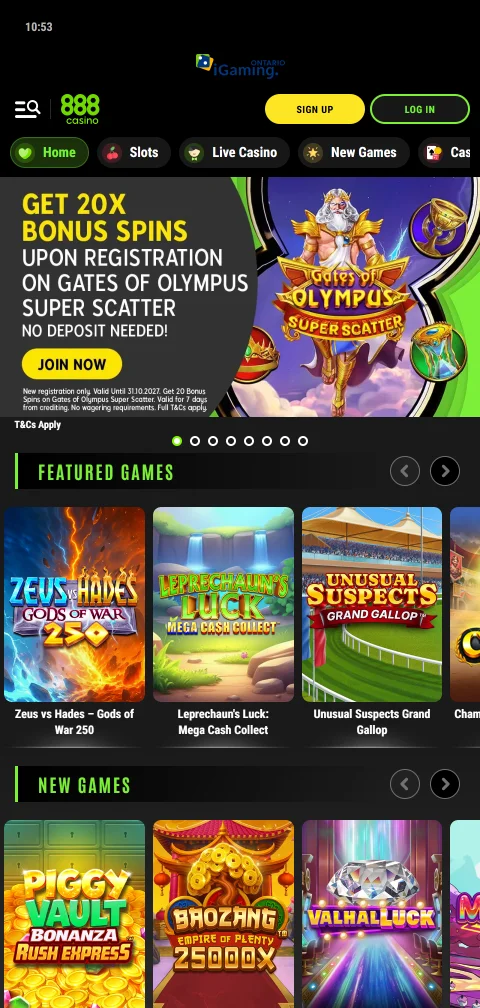
| Key Feature | In-house 888 slots and table games |
| Welcome Bonus | 100% up to €500, 40x wagering |
| Min. Deposit | €10 |
| Number of Games | Approximately 2,000+ |
| Game Providers | 888 in-house studio, Evolution, NetEnt, Pragmatic Play (approx.) |
| Payment Methods | Visa, Mastercard, PayPal, Skrill, NETELLER, Paysafecard, bank transfer |
| Payment Services | Skrill, NETELLER, PayPal, MuchBetter |
| Mobile App | iOS and Android apps, plus browser |
| VIP Programme | Yes, invitation-based VIP Casino Club |
| RTP | Around 95-97% on most slots, varies by title |
| Licence | Gibraltar Remote Gaming Licence No. 112 |
| Operator | 888 Eire Limited (Gibraltar) |
| Launch Date | 1997 |
| Legal Age | 18+ |
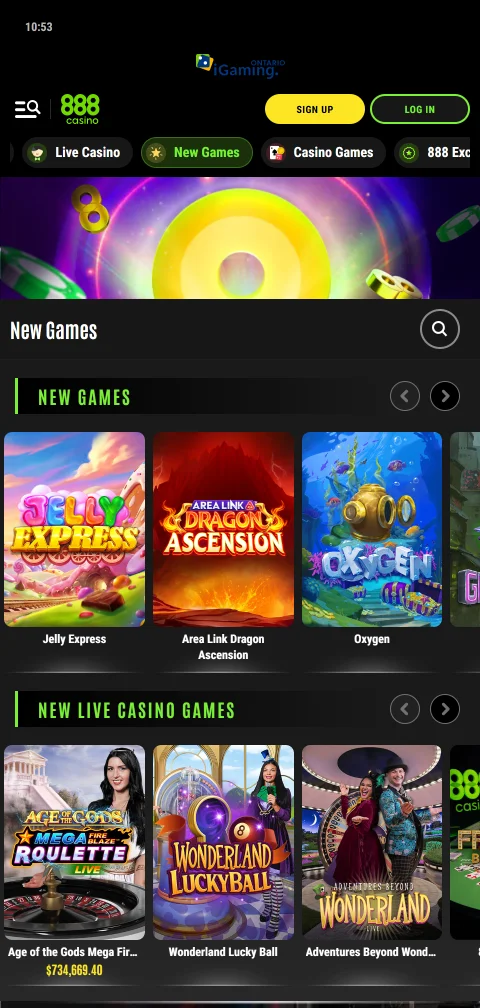

- Irish casino service licensed in Gibraltar under Remote Gaming Licence No. 112, named on every page
- Choice of welcome offers: 100% up to €500 or 100 free spins for a €10 deposit
- Operator history going back to 1997, with its own in-house slot and table studio
- Withdrawal timeframes published per method, including a one-day pending window for Gold VIP members
- Standard pending period of three business days before any withdrawal is processed
- 40x wagering on the match bonus, with Skrill and NETELLER deposits excluded from the offer
- Live chat only available while logged in and during operational hours, which are not published
Live chat at 888 Casino opens only once logged in, through the Help Center, and its operational hours go unpublished; the 888 Casino support assessment sets out what that means for a player locked out of an account.
PlayOJO Casino review
| Key Feature | No-wagering bonuses and OJOplus money back on every bet |
| Welcome Bonus | 50 wager-free spins on Book of Dead, €10 minimum deposit |
| Min. Deposit | €10 |
| Number of Games | 4,000+ (operator also cites over 7,000) |
| Game Providers | Evolution, Pragmatic Play, Play'n GO, NetEnt, Nolimit City, Relax Gaming |
| Payment Methods | Visa Debit, Mastercard Debit, Apple Pay, Instant Bank, Trustly |
| Payment Services | PayPal, Skrill, Neteller, MuchBetter |
| Mobile App | Mobile browser site; native apps not confirmed for Ireland |
| VIP Programme | OJO Levels with Kickers, OJO Wheel and Prize Twister |
| RTP | Varies by game; approximately 94-97% on mainstream slots |
| Licence | Malta Gaming Authority, MGA/CRP/171/2009/01 |
| Operator | Skill On Net Limited, Ta' Xbiex, Malta |
| Launch Date | 2017 |
| Legal Age | 18+ |

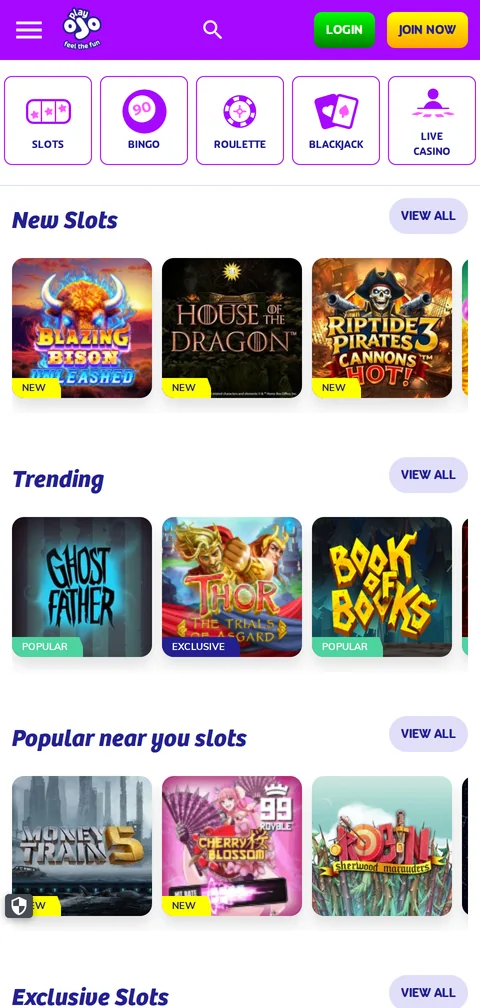
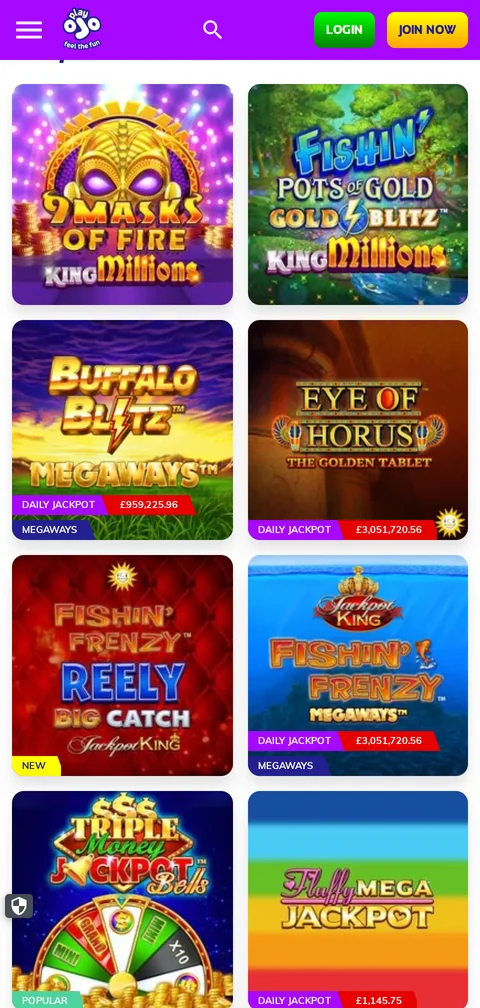
- Welcome free spins carry no wagering, so winnings are paid as withdrawable cash.
- OJOplus returns a small cash percentage on every real-money bet, win or lose.
- No minimum withdrawal on Visa, Mastercard, Apple Pay and Instant Bank payments.
- No telephone support, and the welcome offer is small next to match-bonus rivals.
- Irish GRAI licence still pending; the Irish site currently relies on its Maltese licence.
Live chat and email only, with no phone line and no published response time: the weakest score in our PlayOJO Casino editorial assessment, which also covers eCOGRA escalation through Malta.
Tonybet Casino review
| Key Feature | Combined casino and sportsbook account |
| Welcome Bonus | 100% up to €750 + up to 100 bonus spins |
| Min. Deposit | €20 for the welcome offer |
| Number of Games | 8,000+ (some listings cite 12,000+) |
| Game Providers | Approximately 60, incl. Pragmatic Play, 1x2 Gaming, Amatic |
| Payment Methods | Visa, Mastercard, PayPal, Apple Pay, Google Pay, Revolut |
| Payment Services | Bank transfer, Paysafecard |
| Mobile App | iOS app; browser site on Android |
| VIP Programme | Yes, loyalty programme |
| RTP | Typically 94-97% per slot |
| Licence | Revenue (Ireland) 1017899; Estonian licence for casino |
| Operator | TonyBet OÜ, Tallinn, Estonia |
| Launch Date | 2003 |
| Legal Age | 18+ |
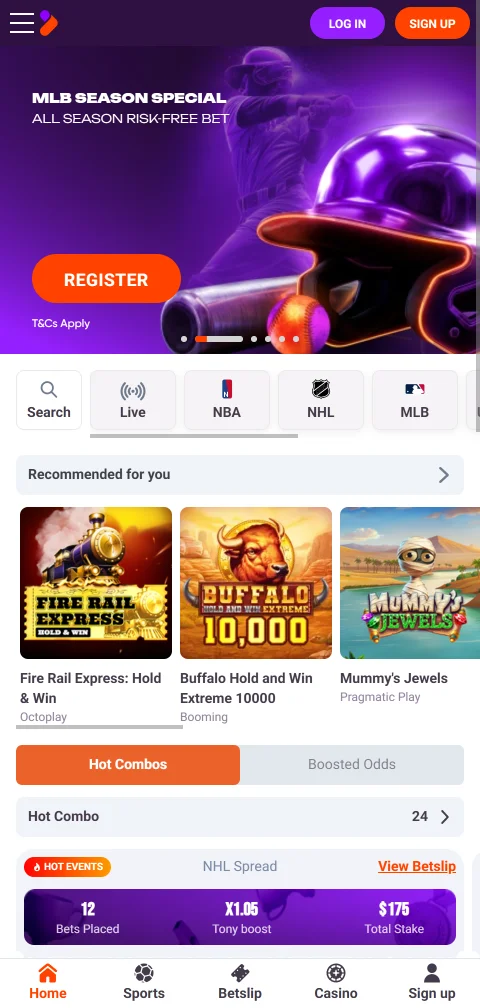

- Welcome package carries 30x wagering, below the 35x-40x common in Irish casino offers
- Listed on the Revenue register of remote bookmakers under licence number 1017899
- E-wallets such as PayPal, Revolut and Apple Pay pay out within 24 hours
- Library of more than 8,000 titles with an Irish Picks category for local favourites
- Casino play rests on an Estonian licence, not on an Irish casino licence
- Debit card withdrawals take 1-3 working days and bank transfers 2-5
- iOS app rates 2.5 out of 5 on the Irish App Store from 30 ratings
Live chat runs 24/7 with replies in about 1-3 minutes, email in around 8-12 hours, and no phone line; read the Tonybet Casino support assessment.
bet365 Casino review
| Key Feature | One wallet shared with the bet365 sportsbook |
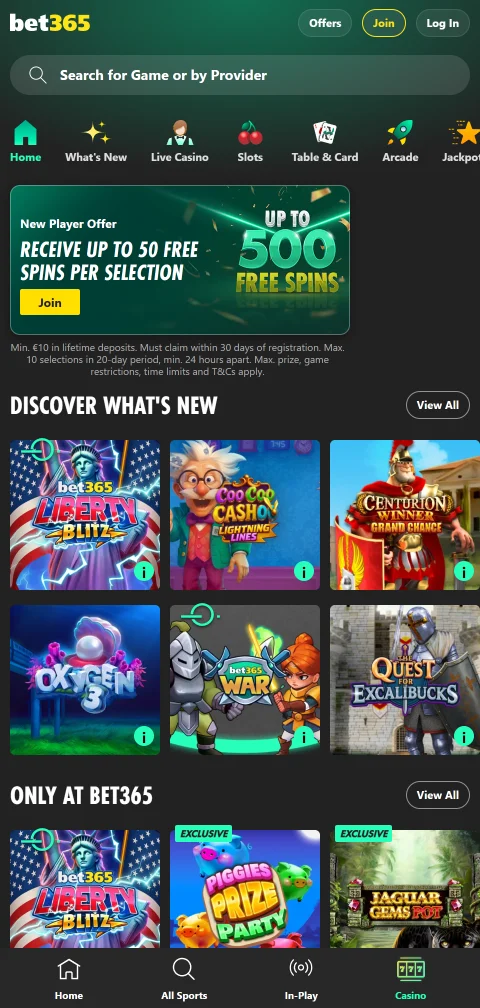
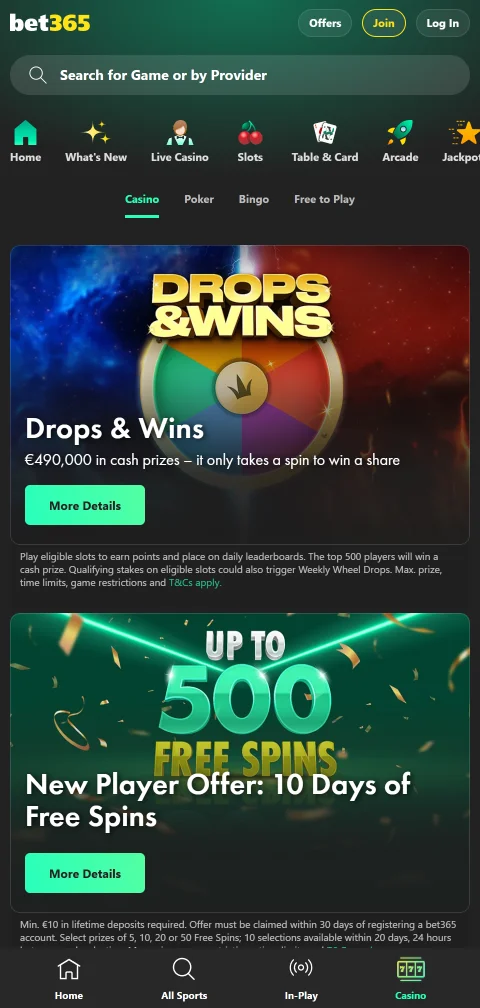
| Welcome Bonus | Up to 200 free spins over 10 days |
| Min. Deposit | €5–€10 depending on method |
| Number of Games | Approximately 1,500+ (unconfirmed) |
| Game Providers | Playtech, in-house titles and other studios (unconfirmed list) |
| Payment Methods | Visa Debit, Mastercard Debit, bank transfer, Trustly |
| Payment Services | PayPal, Apple Pay, Paysafecard |
| Mobile App | iOS and Android, casino inside main app |
| VIP Programme | No public VIP tiers published |
| RTP | Typically 94–97% on slots |
| Licence | GRAI remote betting; casino under MGA (check footer) |
| Operator | bet365 Group / Hillside entities |
| Launch Date | 2000 (bet365 brand) |
| Legal Age | 18+ |
- Stated withdrawal processing target of around four hours, with Visa Direct possibly inside two
- No fees on any listed withdrawal method, with bank transfers up to €50,000
- Free spins welcome offer needs only €10 in lifetime deposits to qualify
- Holds a GRAI remote betting licence, listed on the public Irish register
- Casino, sportsbook and live dealer games share one balance and one login
- GRAI has not yet opened casino licences, so casino cover still relies on Malta
- Free spins prizes of 5, 10 or 20 are randomised, not a fixed amount
- Withdrawals must normally return to the deposit method, which is awkward to change
- No published VIP ladder or tiered loyalty scheme for casino players
Help centre pages publish limits and processing targets, with live chat, email and phone behind them, though Irish support hours go unpublished, as our bet365 Casino support assessment notes.
Betway Casino review
| Key Feature | Casino and sportsbook on one wallet |
| Welcome Bonus | Up to €50 free bet + 50 bonus spins |
| Min. Deposit | €5 (debit card, for the welcome offer) |
| Number of Games | Approximately 500+ slots, plus tables and live |
| Game Providers | Games Global, NetEnt, Pragmatic Play; Evolution live |
| Payment Methods | Visa, Mastercard debit, open banking, e-wallets |
| Payment Services | Debit cards, PayPal, open banking |
| Mobile App | iOS and Android apps, plus browser |
| VIP Programme | Invitation-only; no public tier table |
| RTP | Typically 94-97% on slots |
| Licence | MGA/B2C/130/2006; GRAI licence (betting) |
| Operator | Betway Limited (Malta) |
| Launch Date | 2006 |
| Legal Age | 18+ |
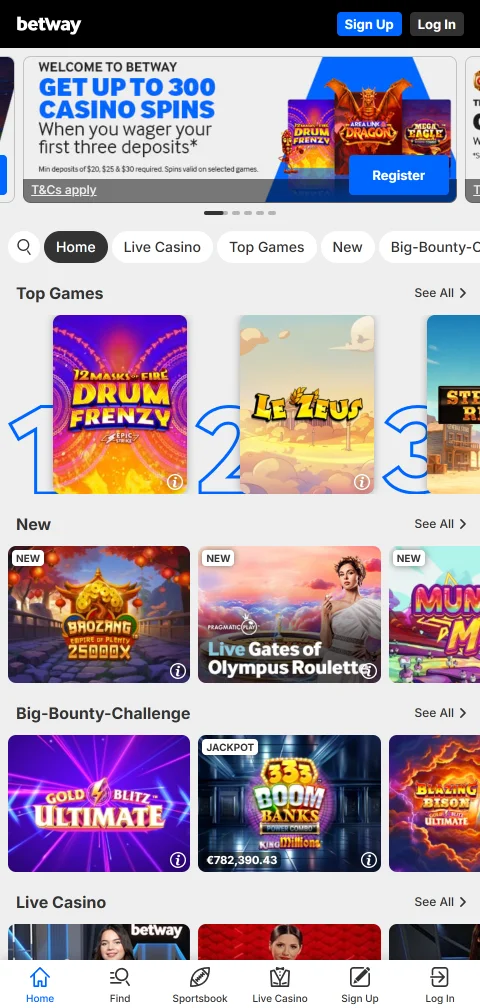
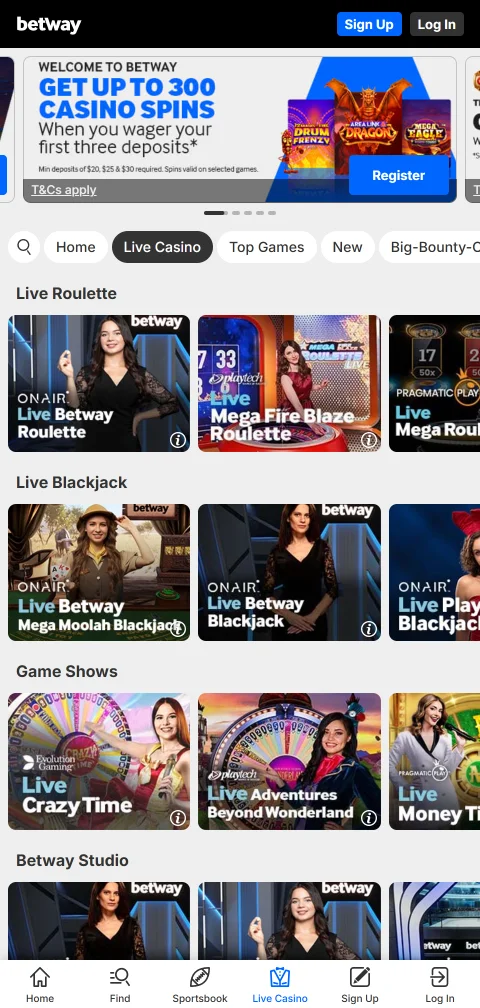
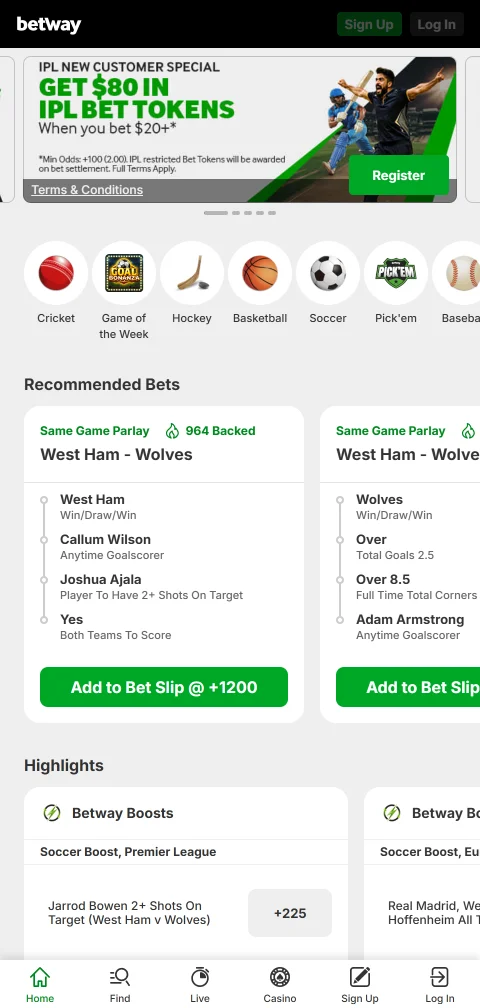
- Malta Gaming Authority licence MGA/B2C/130/2006 covers the casino product for Irish players
- GRAI register lists Betway for remote sports betting since the July 2026 licensing round
- Stated withdrawal processing within 24 hours, with one to two days in total
- Welcome offer starts from a €5 debit card deposit, lower than many rivals
- Bonus spins carry 50x wagering, and the offer expires seven days after registration
- Free bet returns winnings only; the €50 stake itself is never paid back
- Ireland has no online casino licence yet, so casino play relies on Malta
Live chat and email, no Irish phone line and no published hours for Ireland: support is the lowest-scored area in our Betway Casino editorial assessment, which also sets out the escalation routes to the GRAI and Malta.
How we rated casinos accepting Irish players
The ranking is built from published terms, the licence on each regulator’s register and answers given by support to written questions. Commission from operators does not move a placing, and neither does the size of a headline offer when its terms are restrictive.
Bonuses and their terms for Irish accounts
A placing rises when the offer shown to an Irish account carries wagering of 35x or lower on the bonus alone, a stated maximum bet and a cap on winnings written in euro. It falls when wagering applies to deposit plus bonus, when Irish players are excluded in the small print, or when the terms page differs from the offer banner.
Withdrawals, KYC and payout speed in euro
Euro accounts, debit cards, bank transfer and e-wallets with a stated processing window of 24 to 48 hours raise a placing, as does KYC requested at registration rather than at the first withdrawal. A casino falls when its terms allow an open-ended review of every withdrawal, or when it takes credit card deposits, a payment the 2024 Act prohibits for operators it licenses.
Games, software and certified RTP
Games from studios whose titles are certified by an independent testing house, with RTP shown in the game information panel, raise a placing. A lobby that hides RTP, runs lower-RTP versions of known slots without saying so, or lists providers whose games do not load for Irish accounts lowers it.
Mobile site and account controls
A placing goes up when deposit limits, time-outs and self-exclusion sit inside the account menu on mobile and take effect at once. It goes down when the mobile site hides the terms, the licence footer or the limit tools behind a support request.
Licence issuer and register verification
This criterion carries the most weight here. A casino rises when its licence number appears on the issuer’s public register under the same company named in the site’s terms, and when that issuer offers a complaints route open to a player in Ireland. It falls when the footer seal leads to no register entry, or when the licensee is a different company from the one in the terms.
Customer support and complaints handling
Live chat and email in English, a written complaints procedure with a stated response time and the named ADR body raise a placing. Support that cannot say which regulator holds the licence, or that refuses to put a withdrawal decision in writing, lowers it.

Why every casino here holds a foreign licence
The Gambling Regulation Act 2024 put one regulator, the Gambling Regulatory Authority of Ireland, in charge of betting, gaming and lotteries, but it does not switch on all at once, because each part of it waits for a commencement order from the Minister. The first order, made on 4 March 2025, established the GRAI itself, and a second, effective from 5 February 2026, let operators apply for betting licences through a portal that opened on 9 February 2026.
The first remote betting licences were issued on 1 July 2026, which means online sportsbooks serving Irish customers now need a GRAI licence to take bets from people in the State.
Casino games are a different matter. Remote gaming licences, the type an online casino with slots, roulette, blackjack and live dealer tables would need, are phased for 2027 and 2028, and no commencement order opening those applications had been made when this page was last checked. Until that phase opens, there is no Irish licence for an online casino to hold, so every site in the list above is licensed by a regulator outside Ireland, most often the Malta Gaming Authority, the Kahnawake Gaming Commission or a licensing body in Curaçao.
That is the fact this page is built around.
What “accepts Irish players” does and does not mean
A casino accepting Irish players means it opens accounts to residents of Ireland, takes euro and does not block Irish IP addresses or addresses at registration. It does not mean an Irish body has approved it, checked its games or will hear your complaint, and the wording on many landing pages is chosen so that the difference is easy to miss. When you see “licensed” on a casino aimed at Ireland, read on until you find who issued the licence and whether the number checks out.
What an MGA, Kahnawake or Curaçao licence covers
A gambling licence protects the players of the jurisdiction that issued it first and everyone else second, and how far that second tier reaches depends on the regulator. The three issuers that turn up most often on casinos open to Ireland differ in what they require of an operator and in whether a player abroad has anywhere to take a dispute.
The Malta Gaming Authority runs a public licensee register, sets rules on segregated player funds and responsible gambling tools, and accepts complaints from players of its licensees, including those outside Malta. That makes an MGA licence the most checkable of the three, though it remains a Maltese licence enforced from Malta.
The Kahnawake Gaming Commission licenses operators from the Mohawk Territory of Kahnawake in Quebec and keeps its own register and complaints procedure. Its reach over operators is real but narrower, and its decisions are not enforceable by any Irish body.
Curaçao reorganised its licensing under a national ordinance that replaced the older master-licence and sub-licence system, and a Curaçao licence today should name the issuing authority and a licence number you can look up. Older seals that point to a master licensee rather than the operator itself are the ones to treat with the most caution, because there may be no complaint route behind them at all.
None of the three gives you the standing an Irish licence will, since the GRAI’s powers under the 2024 Act to investigate, fine and order a refund apply to its own licensees and not to a company licensed in Malta or Curaçao.
Foreign licences side by side for Irish players
The table sets the licence types a player in Ireland is likely to meet against what they cover and where a complaint goes. The status column reflects the GRAI’s published phasing and the regulators’ own registers rather than anything an operator says about itself.
| Licence | Issued by | Covers | Status for Ireland | Complaint route |
|---|---|---|---|---|
| Remote betting | GRAI | Online sports betting | Issued since 1 July 2026 | GRAI |
| Remote gaming | GRAI | Online casino games | Phased for 2027-2028 | Not yet available |
| MGA licence | Malta Gaming Authority | Casino and betting | Foreign, widely used | MGA player support |
| Kahnawake | Kahnawake Gaming Commission | Casino and betting | Foreign | KGC complaints process |
| Curaçao | Curaçao Gaming Authority | Casino and betting | Foreign | Varies by licensee |
| UKGC licence | UK Gambling Commission | Great Britain only | Does not cover Ireland | Not for Irish residents |
KYC, source of funds and withdrawal checks
Most withdrawal disputes on foreign-licensed casinos are not about the casino refusing to pay but about verification, because anti-money-laundering rules in Malta and elsewhere require the operator to know who you are and where the money came from before it releases a significant sum. The operator is obliged to ask, and its terms usually let it hold a withdrawal until the documents arrive.
Standard KYC means photo identification, proof of address dated within the last three months and, for card users, a photo of the card with the middle digits covered. Source-of-funds requests go further and can ask for payslips, bank statements or proof of a property sale or inheritance, and they tend to arrive once deposits cross an internal threshold that the operator rarely publishes.
Upload identity documents before you deposit.
A casino that verifies you at the start has already done the work it would otherwise do when you ask for money, and a withdrawal then waits only on the stated processing window. One that lets you play unverified and then asks for everything at once, sometimes with a request for further documents after each upload, is where complaints to regulators come from, and it is why this page rates the timing of KYC under the banking criterion rather than treating it as paperwork.
Credit cards
The 2024 Act bars operators it licenses from accepting credit card payments for gambling. A foreign-licensed casino is outside that rule, so some still take credit cards from Irish accounts, and the list above marks them down for it.
Bonus terms and Irish advertising rules
The 2024 Act restricts inducements by its licensees, including free bets offered to draw a player in or keep them gambling, and limits gambling advertising on broadcast media during the day. Those rules bind GRAI licensees, and since no online casino holds a GRAI licence yet, a casino licensed in Malta or Curaçao is not bound by them in Ireland.
So the offers you meet on foreign-licensed casinos follow the issuing regulator’s rules, not Irish ones.
What matters most is the wagering requirement and what it applies to. A €100 bonus with 35x wagering on the bonus alone asks for €3,500 in qualifying bets, while the same 35x on deposit plus bonus asks for €7,000, and slots usually count in full while table games and live casino count for a fraction or nothing. Check the maximum bet allowed while wagering, the time limit and any cap on winnings before accepting, and check that the terms page says the same as the banner.
An Irish licence against a foreign one
The comparison sets a GRAI licence, as the 2024 Act defines it, against an MGA licence, the foreign licence with the most published protections among those common on casinos open to Ireland. For casino games the first column does not yet exist in practice, and that is the point of setting them side by side.
GRAI licence (Irish) | MGA licence (Maltese) |
|---|---|
| Irish regulator can fine, suspend or revoke | Enforcement only from Malta |
| Remote gaming licences phased for 2027-2028 | Available to casino operators now |
| Credit card gambling barred by the 2024 Act | Credit cards governed by Maltese rules |
| Public register of licensees | Public register of licensees |
Checking a casino's licence yourself
A licence seal in a footer is an image, and anyone can place an image on a page. The only check that counts is the issuer’s own register, reached by typing the regulator’s address yourself rather than clicking the seal.
It takes a few minutes and settles the question this page is about.
Four checks on a casino's licence
These are the four checks we run on every casino before it enters the list, and the order matters, because each step depends on the one before it.
- Step 1
Find the licensee in the terms
Open the terms and conditions and note the company name, its registered address and the licence number it quotes. The licensee is the company, not the brand on the logo. - Step 2
Open the regulator's register directly
Type the regulator's web address into the browser yourself and search its register for the company or licence number, rather than following the footer seal. - Step 3
Match company, status and domain
Confirm the register lists the same company, an active status and, where the regulator shows them, the domain you are about to use. Any mismatch is reason to stop. - Step 4
Note the complaints route in writing
Find the casino's complaints procedure and the ADR body or regulator it names, and save a copy before depositing so you know where a dispute goes.
Where to complain when it goes wrong
Start with the casino’s own complaints procedure and put everything in writing, because a regulator or ADR body will ask for the operator’s final answer before it looks at your case. Keep screenshots of the terms as they stood when you accepted a bonus, since terms change and the version that applies is the one you agreed to.
If the operator’s answer does not resolve it, the next step depends entirely on who issued the licence. An MGA licensee’s players can go to the MGA’s player support function, a Kahnawake licensee’s players to the Commission’s complaints process, and a Curaçao licensee’s players to whatever route that licensee names, which in some cases is an ADR service and in others nothing at all.
The GRAI cannot take a complaint against a casino it has not licensed.
That is the clearest practical difference between a foreign licence and an Irish one, and it will remain so until remote gaming licences are issued, at which point casinos serving Ireland will need a GRAI licence and the GRAI’s complaints and enforcement powers will reach them.
Gambling responsibly on a foreign-licensed casino
A casino licensed abroad is not covered by the national self-exclusion register the 2024 Act provides for, so the tools inside your account are the ones that apply. Set a deposit limit before your first deposit, because a limit chosen in advance holds better than one chosen mid-session, and use the time-out or self-exclusion option in the account menu if play stops being something you choose. A self-exclusion on one casino does not carry over to its sister brands unless the operator says so in writing. Treat any money you deposit as spent on entertainment, never as a way to recover losses or pay bills. If gambling is affecting your money, work or relationships, the support organisations listed below offer free and confidential help to anyone in Ireland.
What to keep in mind before you register
The figure worth remembering is the gap between 1 July 2026, when the GRAI issued its first remote betting licences, and the remote gaming phase set for 2027 and 2028, because every casino in this list sits inside that gap. The ranking and its licence checks were last updated on 30 October 2026, and once casinos can hold a GRAI licence the licence criterion will be rebuilt around it, which is likely to reorder this list more than any bonus change.
Questions from Irish players about foreign-licensed casinos
Is it legal for Irish players to use online casinos?
Irish law does not make it an offence for a player to use an online casino. The obligations under the Gambling Regulation Act 2024 fall on operators, and while remote gaming licences are not yet open, casinos accepting Irish players do so under licences issued outside Ireland.
Does the GRAI license online casinos yet?
No. The GRAI has issued remote betting licences since 1 July 2026, but remote gaming licences, which cover online casino games, are phased for 2027 and 2028, and no commencement order opening those applications had been made when this page was last checked.
Is an MGA licence as good as an Irish one?
It is not the same thing. The MGA can sanction its licensees and handle player complaints, but it enforces from Malta under Maltese law, and the GRAI’s powers to investigate, fine and order redress apply only to the operators it licenses itself.
Can I use a credit card at these casinos?
The 2024 Act bars GRAI licensees from accepting credit card payments for gambling, but foreign-licensed casinos are outside that rule and some still accept them. Debit cards, bank transfer and e-wallets are the methods this page rates, and credit card acceptance lowers a placing.
Why did a casino ask for my bank statements?
That is a source-of-funds request, made under anti-money-laundering rules in the licensing jurisdiction. Operators must establish where large deposits came from, and the threshold that triggers the request is usually internal and unpublished. Withdrawals are normally held until the documents are accepted.
Do I pay tax on casino winnings in Ireland?
Gambling winnings are generally not subject to income tax for players in Ireland, and betting duty is charged to operators rather than customers. If gambling is your trade rather than a pastime, the position can differ, and Revenue is the body to ask.
Can a UK-licensed casino accept Irish players?
A UK Gambling Commission licence covers customers in Great Britain, not Ireland. UK brands that serve Irish players usually do so through a separate company licensed in Malta or elsewhere, so check the terms for which licensee your account is actually with.
More about online casinos






When comparing these casinos, look first at the licensee company in the terms rather than the brand name on the card, because two brands can share one Malta licence and one complaints route.