













Zodiac Casino review
| Key Feature | €1 entry to the Mega Money Wheel |
| Welcome Bonus | 80 chances for €1, up to €480 in matches |
| Min. Deposit | €1 first deposit, €10 after |
| Number of Games | Over 1,000 |
| Game Providers | Games Global (Microgaming) and partner studios |
| Payment Methods | Visa, Mastercard, bank transfer |
| Payment Services | Skrill, Neteller, Paysafecard |
| Mobile App | Mobile browser; check site for app download |
| VIP Programme | Casino Rewards, six levels |
| RTP | Approximately 96% on most slots |
| Licence | Kahnawake Gaming Commission, 00972 |
| Operator | Fresh Horizons Limited (Casino Rewards) |
| Launch Date | 2001 |
| Legal Age | 18+ |
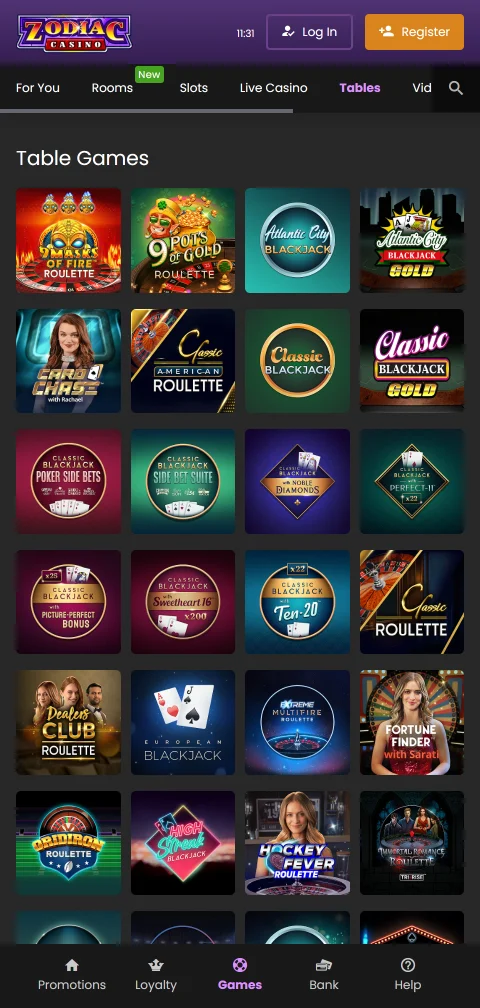
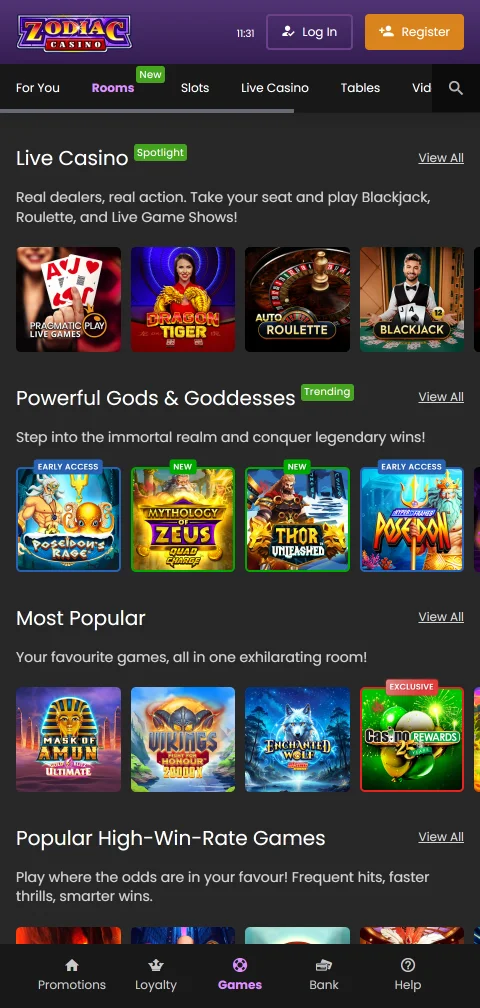
- A €1 first deposit buys 80 chances on the Mega Money Wheel jackpot game
- eCOGRA Safe and Fair certificate, with eCOGRA also named as the dispute service
- Loyalty points carry across every Casino Rewards sister site, so one balance serves several brands
- The first two welcome bonuses carry 200x wagering, which few players will ever clear
- Every withdrawal sits in a 48-hour pending period before processing even begins
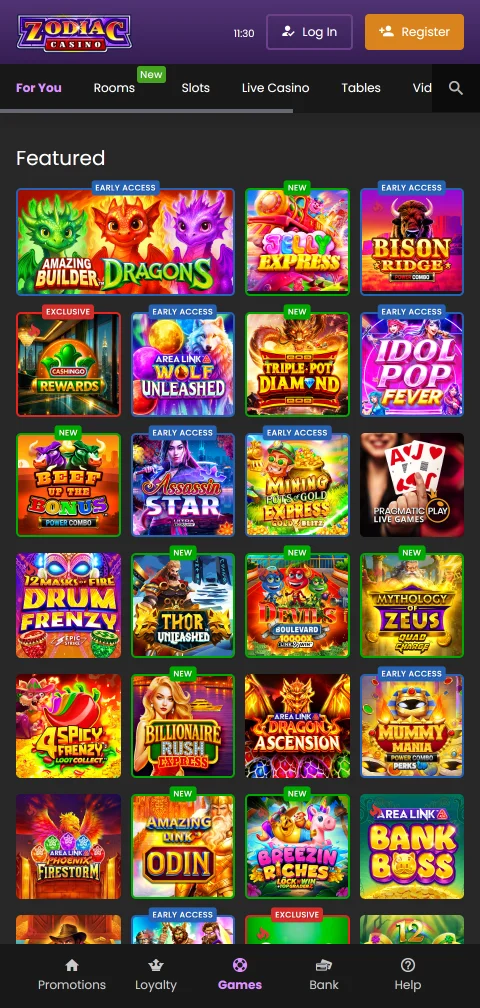
Over 1,000 games, mostly from Games Global, including the Mega Moolah progressives, are assessed in the Zodiac Casino games overview.
PlayOJO Casino review
| Key Feature | No-wagering bonuses and OJOplus money back on every bet |
| Welcome Bonus | 50 wager-free spins on Book of Dead, €10 minimum deposit |
| Min. Deposit | €10 |
| Number of Games | 4,000+ (operator also cites over 7,000) |
| Game Providers | Evolution, Pragmatic Play, Play'n GO, NetEnt, Nolimit City, Relax Gaming |
| Payment Methods | Visa Debit, Mastercard Debit, Apple Pay, Instant Bank, Trustly |
| Payment Services | PayPal, Skrill, Neteller, MuchBetter |
| Mobile App | Mobile browser site; native apps not confirmed for Ireland |
| VIP Programme | OJO Levels with Kickers, OJO Wheel and Prize Twister |
| RTP | Varies by game; approximately 94-97% on mainstream slots |
| Licence | Malta Gaming Authority, MGA/CRP/171/2009/01 |
| Operator | Skill On Net Limited, Ta' Xbiex, Malta |
| Launch Date | 2017 |
| Legal Age | 18+ |

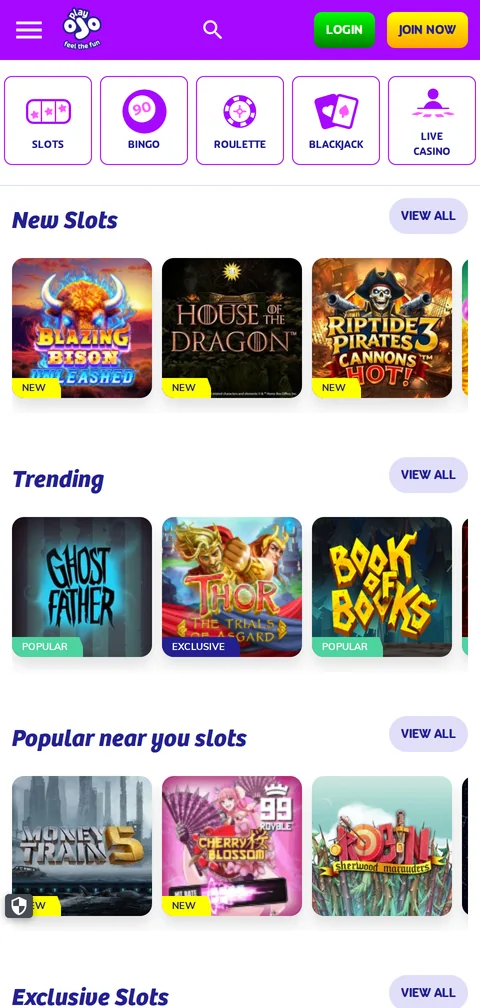
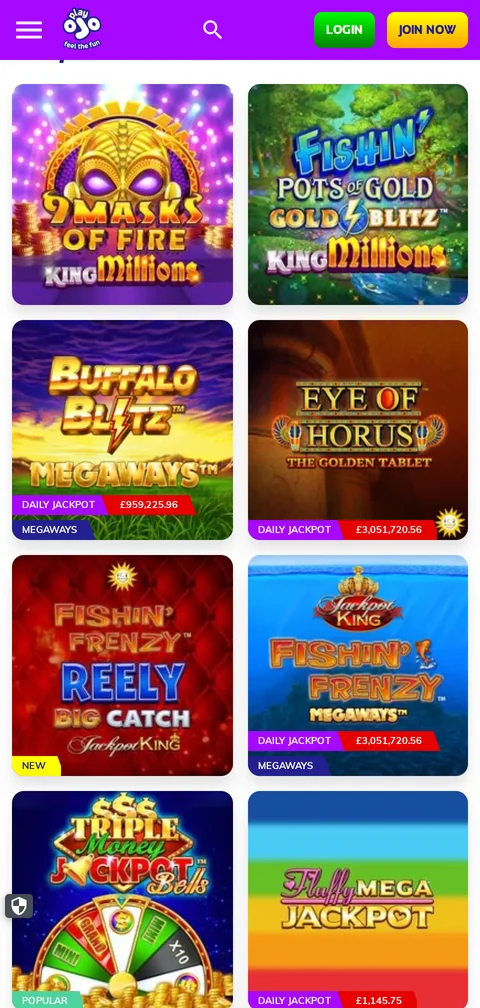
- Welcome free spins carry no wagering, so winnings are paid as withdrawable cash.
- OJOplus returns a small cash percentage on every real-money bet, win or lose.
- No minimum withdrawal on Visa, Mastercard, Apple Pay and Instant Bank payments.
- No telephone support, and the welcome offer is small next to match-bonus rivals.
- Irish GRAI licence still pending; the Irish site currently relies on its Maltese licence.
More than 4,000 games from over thirty studios approved on the MGA register, including Evolution, Play’n GO and Nolimit City, plus live tables reserved for Ireland: our PlayOJO Casino games overview explains the RTP versions behind them.
Jackpot City Casino review
| Key Feature | Four-part match bonus plus daily Million spins |
| Welcome Bonus | 100% up to €400 (part of €1,600 package) |
| Min. Deposit | €10 |
| Number of Games | Not published; approximately 450-600 |
| Game Providers | Games Global, Pragmatic Play, OnAir Entertainment |
| Payment Methods | Visa, Mastercard, Skrill, ecoPayz |
| Payment Services | Debit cards, e-wallets, bank transfer |
| Mobile App | No Irish app; mobile browser site |
| VIP Programme | Loyalty points programme |
| RTP | Typically around 95-97% per game |
| Licence | Kahnawake Gaming Commission (Baytree Interactive) |
| Operator | Baytree Interactive Limited (Guernsey) |
| Launch Date | 1998 |
| Legal Age | 18+ |



- Welcome package spreads up to €1,600 across four deposits, each starting from just €10
- Operating since 1998, with the Irish site listed on the Kahnawake permit-holders register
- Games Global jackpot slots including Mega Moolah, plus live tables from OnAir Entertainment
- No total game count is published, and the Irish lobby credits only three studios
- No GRAI licence yet and no native app for Irish players, only the mobile site
Games Global supplies the slots and Mega Moolah progressives, Pragmatic Play adds volume and OnAir Entertainment runs live roulette and blackjack. The lobby of approximately 450-600 titles is weighed in the Jackpot City Casino games overview, studio by studio.
Spin Casino review
| Key Feature | Irish-facing site running since 2001 (as Spin Palace) |
| Welcome Bonus | 100% up to €400 on first deposit |
| Min. Deposit | €10 |
| Number of Games | Approximately 1,400 |
| Game Providers | Games Global, Pragmatic Play, Hacksaw Gaming, Spribe, Blueprint |
| Payment Methods | Visa, Mastercard, paysafecard, Skrill, NETELLER, MuchBetter |
| Payment Services | Swift bank transfer (withdrawals only) |
| Mobile App | Mobile browser site; app availability to check per store |
| VIP Programme | Loyalty scheme; tier details on the site |
| RTP | Typically 94-97% on slots |
| Licence | Offshore/international; check footer before depositing |
| Operator | Not confirmed; named in the site terms |
| Launch Date | 2001 |
| Legal Age | 18+ |



- Welcome offer is split €400, €300 and €300, so you can stop after one deposit
- Seven named studios on the Irish page, from Games Global to Hacksaw Gaming
- Six two-way payment rails listed for Ireland, with Swift added for withdrawals
- Brand history goes back to 2001, when it traded as Spin Palace
- Wagering reported by Irish reviewers at up to 70x, well above the 35x seen elsewhere
- Licence details are not shown on the Irish landing page we read
- No Irish GRAI gaming licence exists yet, so Irish complaint routes do not apply
Approximately 1,400 games from seven studios, including Games Global jackpots, Pragmatic Play, Hacksaw Gaming and Spribe crash titles, with slot RTP typically 94% to 97%, are covered in the Spin Casino games overview.
Lucky Nugget Casino review
| Key Feature | Three-step welcome package from €1 |
| Welcome Bonus | 40 bonus spins for a €1 deposit |
| Min. Deposit | €1 (bonus step one), €5 for later steps |
| Number of Games | Approximately 500-700 titles |
| Game Providers | Games Global (Microgaming) catalogue, Evolution live tables (approx.) |
| Payment Methods | Visa Debit, Mastercard Debit, bank transfer |
| Payment Services | Skrill, Neteller, Neosurf, ecoPayz |
| Mobile App | Mobile browser site; app availability varies by region |
| VIP Programme | Loyalty points scheme (shared-platform style) |
| RTP | Approximately 95-97% across slots |
| Licence | Kahnawake Gaming Commission (per recent reviews; check footer) |
| Operator | Unconfirmed; check the site footer |
| Launch Date | Late 1990s (approximately) |
| Legal Age | 18+ |



- A €1 first deposit gets you 40 spins, a low entry point for a careful first visit.
- E-wallet withdrawals through Skrill or Neteller land in roughly 24-48 hours after the pending period.
- A long-running Games Global catalogue, with Mega Moolah progressive jackpots tied into the welcome steps.
- Welcome terms reported at 200x wagering, far above the 35x-40x common at comparable sites.
- Minimum withdrawal of €50 is high, and no GRAI licence exists yet for Irish players.
Games Global slots, the Mega Moolah progressives and live tables reported from Evolution, across approximately 500-700 titles, examined in the Lucky Nugget game library overview.
How we rank casinos for small-budget play
The ranking is built from published terms, game settings and licence records, read against one question: does this casino work for someone betting cents rather than euros? Commercial arrangements and headline bonus sizes do not move a placing, and neither does the size of the game library on its own.
Small-deposit bonuses and their terms
A welcome offer that unlocks from a €10 deposit raises a placing; one that needs €20 or more lowers it. Wagering of 35x or less on the bonus amount scores well, while a maximum bet rule below 50c during wagering is fine for low stakes. Slots contributing 100% and table games at 10% or less are noted plainly, because a small-stakes player who prefers roulette may clear almost nothing.
Minimum deposits, withdrawals and payout speed
A €10 minimum deposit and a €10 or lower minimum withdrawal raise a placing. A €20 withdrawal floor, or a fee on withdrawals under a set amount, lowers it, since on a small balance a €2.50 charge is a large share. Stated processing within 48 hours on card or e-wallet counts in the casino’s favour.
Low-limit games and software
This criterion carries the most weight on this page. A placing rises when the slot lobby offers spins from 10c or less, when live roulette and blackjack tables open at €1 or under, and when RNG tables accept 50c or 10c chips. It also rises where the casino shows which RTP version of each slot it runs, since studios such as Pragmatic Play and Play’n GO release the same title at several settings. A lobby where the cheapest live blackjack seat is €5, or where RTP is hidden from the game information panel, lowers the placing.
Mobile use and bet controls
Small stakes mean many bets, so the stake selector matters. A placing rises when the minimum bet is reachable in one tap and the lobby can be filtered by table limit. Live tables that show their minimum before you join score well; a lobby that only reveals limits after loading does not.
Licensing and game certification
An operator licensed to serve Irish players, with its licence number shown in the footer, raises a placing. So does game certification from a testing laboratory such as eCOGRA, GLI or iTech Labs, named on the site and linked where possible. Missing licence details, or an RNG claim with no laboratory behind it, lowers the placing regardless of how low the limits are. Low stakes do not make an unlicensed casino a smaller risk: a frozen balance of €40 is still your €40, and there is less recourse without a regulator.
Customer support and how reachable it is
Live chat available in the evening, when most recreational play happens, raises a placing. We also look at whether support answers questions about minimum bets and bonus contribution clearly, quoting the terms rather than guessing. Email-only support, or replies that only point back to the FAQ, lower it.

What counts as low stakes at an Irish casino
Low stakes is a description of bet size, not of a casino type. In practice it means slot spins from 10c to 20c, RNG table games from 10c or 50c per hand, and live dealer tables that open at €1 or less. Some lobbies go further, with penny-style slots that accept 1c per line, though the total spin still depends on how many lines are active.
The casinos in the list above were matched on those limits, using the minimums shown in their own game lobbies and terms.
What the term does not mean is a softer game. A roulette wheel taking 50c chips is the same wheel that takes €50 chips, with the same 37 pockets and the same payouts. The slot running at 10c a spin uses the same random number generator, the software that decides every outcome independently of the last, as it would at €10. The difference is entirely in how much each outcome moves your balance, and therefore in how many decisions a fixed budget pays for.
That last point is the real case for playing small. Forty euro at €2 a spin is twenty spins; at 20c it is two hundred. Neither session is more likely to finish ahead, but the longer one gives the averages more room to show themselves, which is a different thing from luck turning.
Why a smaller bet does not change the odds
RTP, or return to player, is the share of all money staked that a game pays back over a very large number of rounds. A slot certified at 96% returns €96 for every €100 wagered across millions of spins, and keeps the other €4 as its edge.
Apply that to a real budget. Suppose you stake €500 in total over an evening, whether as 2,500 spins at 20c or 250 spins at €2. The long-run expectation is the same in both cases: a loss of about €20. The 20c session will usually feel smoother, because each result is smaller relative to the balance, but the expected cost per euro staked has not moved.
A short session proves nothing either way.
Two hundred spins on a high-volatility slot, one where wins are rare and large, can end far above or far below the RTP figure, and that variation is expected rather than a sign of anything wrong. Volatility is where bet size does interact with experience. A player on a small balance and a volatile game can run out of funds before a single feature lands, while the same balance on a low-volatility slot, with frequent small wins, tends to last longer. Studios rarely publish an exact hit frequency, and where a game’s information panel does not state one, this page does not guess at it.
One correction is worth repeating because the myth is so persistent: no slot is ever “due”. Each spin is independent, so a machine that has not paid for an hour is exactly as likely to pay on the next spin as one that paid a minute ago.
Small stakes (10c–50c) | Larger stakes (€2 and up) |
|---|---|
| Same RTP and house edge on the same game version | Same RTP and house edge on the same game version |
| Many more rounds from a fixed budget | Far fewer rounds before the budget is spent |
| Bonus wagering cleared slowly, spin by spin | Bonus wagering cleared faster per session |
| Max-bet bonus rules rarely an issue | Easy to breach a €5 max-bet rule by accident |
| Jackpot features sometimes need a higher stake to qualify | Full access to stake-linked jackpot tiers |
| Swings small relative to the balance | Single results can empty a balance quickly |
Bonuses and wagering on a small budget
Wagering is the number of times a bonus, or sometimes bonus plus deposit, must be staked before it can be withdrawn. It is where low stakes collide with the arithmetic, and it deserves a worked example.
Take a €20 bonus with 35x wagering on the bonus amount. That is €700 to stake. At 20c a spin it means 3,500 spins, and on a 96% slot the expected loss across that volume is about €28, which is larger than the bonus itself. At 10c the spin count doubles to 7,000 while the expected loss stays at €28, because the cost depends on the total staked, not on the size of each bet. A bonus with 10x wagering on the same €20 needs only €200 staked, with an expected cost near €8. That gap, rather than the headline amount, is what decides whether an offer suits small play.
Game contribution matters just as much. Many casinos count slots at 100% and roulette or blackjack at 10% or nothing, so a table player at 50c a hand may barely move the requirement.
Check also for a minimum stake per spin on bonus funds, which a few operators set, and for free spins fixed at 10c that cannot be raised or lowered.
How to check a casino's limits before depositing
Minimum bets are not always where you expect them. These four checks take a few minutes, and they use only what the casino publishes before you hand over any money.
- Step 1
Open the lobby without an account
Most Irish-facing casinos let you browse the game lobby logged out. Filter live tables by limit, or open a few and read the stated minimum on the table card. - Step 2
Read the slot's stake range and RTP
Open the information panel inside a demo version of the slot. It shows the minimum and maximum spin and, on most modern titles, the RTP version the casino has chosen to run. - Step 3
Find the deposit and withdrawal floors
The banking or payments page lists the minimum deposit and minimum withdrawal for each method. Note any fee charged on small withdrawals, since it hits a low balance hardest. - Step 4
Read the bonus terms in full
Look for the wagering multiple, what it applies to, game contribution percentages and any minimum or maximum stake on bonus funds. If the terms are unclear, ask live chat and keep the reply.
Slots, RTP versions and the same game twice
Many studios release one slot at several RTP settings and let each casino choose. A single title can exist at roughly 96%, 94% and lower configurations, and the artwork, features and minimum bet look identical across all of them.
For a low-stakes player this matters more than it first seems. Because small bets mean long sessions, total turnover climbs quickly, and the RTP gap is charged on every euro of it. Over €1,000 staked in 10c spins, the difference between a 96% and a 94% version of the same game is about €20 in expected cost, which can be the whole evening’s budget. The bet size is low; the turnover is not.
The figure to trust is the one in the game’s own information panel at the casino you are playing, not a number quoted from the studio’s website or a review, since the review may describe a different version. Where a casino hides the panel or omits the RTP, treat the setting as unknown rather than assuming the highest one.
Sister sites, casinos run by the same operator on the same platform, often share their RTP choices, so one site’s settings can hint at another’s but do not confirm them.
House edge on low-limit table games
Table games at €1 or 50c a hand carry the same mathematics as the high-limit tables, and some bets cost far more than others. The figures below are the standard house edges for each bet under the rules named, expressed as the average cost per €100 staked over the long run.
| Game and bet | Rules assumed | House edge | Cost per €100 |
|---|---|---|---|
| European roulette, any bet | Single zero, 37 pockets | 2.70% | €2.70 |
| American roulette, most bets | Double zero, 38 pockets | 5.26% | €5.26 |
| Blackjack, basic strategy | 6–8 decks, 3:2, dealer stands soft 17 | About 0.5% | About €0.50 |
| Baccarat, banker bet | 8 decks, 5% commission | 1.06% | €1.06 |
| Baccarat, tie bet | 8 decks, pays 8 to 1 | 14.36% | €14.36 |
Where small tables hide a worse rule
The table above assumes standard rules, and low-limit tables do not always offer them. The most common difference is in blackjack, where some cheaper tables pay 6:5 on a natural instead of 3:2. That single change adds roughly 1.4 percentage points to the house edge, turning a game that costs about 50c per €100 into one that costs nearly €2.
Roulette has its own version of the trap. A €1 American wheel may sit beside a €2 European one, and the extra pocket nearly doubles the edge.
A cheaper seat with worse rules is often the more expensive game. The paytable or rules panel on every live and RNG table states the blackjack payout, the number of decks and the zero layout, and reading it takes less time than one hand. Side bets deserve the same scrutiny: they usually accept small stakes and almost always carry a higher edge than the main game, though the exact figure depends on the paytable the casino has chosen, so it should be read from the table rather than assumed.
Live dealer tables at €1 and under
Live dealer games, streamed from a studio with a human croupier, used to start at €5 or more. Low-limit tables have since become common, with live roulette from 10c or 20c per chip at several providers and blackjack seats from €1, though each casino chooses which tables it carries.
Two practical limits apply. Seated blackjack tables have a fixed number of places, so a €1 table may be full while a €10 one is open; “bet behind”, where you stake on a seated player’s hand, is the usual workaround and follows that player’s decisions. Game-show titles accept very small stakes too, but their RTP varies by bet segment, and each segment’s figure is listed in the game’s help screen.
Speed is the hidden cost.
A live roulette round takes far longer than an RNG spin, so the same budget lasts longer in real time at a live table, while an RNG version at 10c can burn through more turnover per hour than it seems.
Keeping small stakes small
Low stakes feel safe, and that feeling is exactly why they need limits of their own. Small bets add up through volume: 10c spins at a quick pace can reach hundreds of euro in turnover within an hour, and turnover is what the house edge is charged on. Set a deposit limit in your account before you start, and decide on a session length as well as a budget. Use the reality-check reminders most licensed casinos offer, and treat any money spent as the price of entertainment rather than a route to income. If chasing losses, playing longer than planned or hiding play from others becomes familiar, the self-exclusion and cooling-off tools in your account settings are there to use, and the support organisations listed below offer confidential help.
What to remember before you play small
If one number from this page is worth keeping, make it the cost per €100 staked, because it applies whatever the bet size. The limits, wagering terms and RTP displays behind this ranking were last checked on 18 September 2026. A placing here would change if a casino raised its table minimums, moved its slots to lower RTP versions, or tightened bonus contribution for small bets. This page deliberately leaves out progressive jackpots, which often need a higher stake to qualify for the largest prize and deserve their own explanation.
Questions about playing at low stakes
What is the lowest bet I can usually place at an online casino?
Slots commonly start at 10c or 20c per spin, and some accept 1c per line. RNG table games often start at 10c or 50c, and live roulette can begin at 10c to 20c per chip. Each casino sets which tables it carries, so check the lobby before depositing.
Do low stakes improve my chances of winning?
No. The RTP and house edge are the same at 10c as at €10 on the same game version. A smaller bet lets a budget cover more rounds, which makes sessions longer and smoother, but the expected cost per euro staked does not change at all.
Is a bonus worth taking if I only bet small amounts?
It depends on the wagering. A €20 bonus at 35x means €700 staked, with an expected loss on a 96% slot of about €28. At 10x the expected cost falls to about €8. Low wagering and full slot contribution matter far more than the headline amount.
Which table game is cheapest to play at low limits?
Blackjack with basic strategy and standard rules carries a house edge of about 0.5%, followed by the baccarat banker bet at 1.06% and European roulette at 2.70%. Avoid 6:5 blackjack and the baccarat tie bet, which cost considerably more per euro staked.
How do I find a slot's RTP at a specific casino?
Open the game and look for the information or help panel, usually behind an “i” or menu icon. Most modern slots state the RTP version the casino runs there. If it is missing, treat the setting as unknown, since the same title can run at several RTP levels.
Can a low-stakes slot be due to pay out?
No. Every spin is decided independently by the random number generator, so past results have no effect on the next one. A slot that has not paid for hours is exactly as likely to pay on the next spin as one that paid a moment ago.
More about online casinos







Compare the cheapest live seat before the slot minimum. Nearly every lobby has 10c spins, but €1 blackjack is rarer and separates these casinos more clearly.