







PlayOJO Casino review
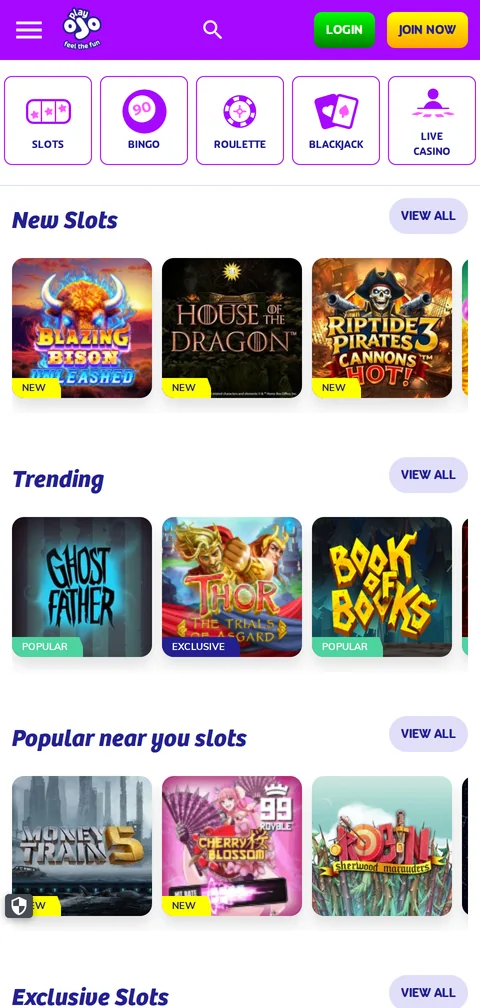
| Key Feature | No-wagering bonuses and OJOplus money back on every bet |
| Welcome Bonus | 50 wager-free spins on Book of Dead, €10 minimum deposit |
| Min. Deposit | €10 |
| Number of Games | 4,000+ (operator also cites over 7,000) |
| Game Providers | Evolution, Pragmatic Play, Play'n GO, NetEnt, Nolimit City, Relax Gaming |
| Payment Methods | Visa Debit, Mastercard Debit, Apple Pay, Instant Bank, Trustly |
| Payment Services | PayPal, Skrill, Neteller, MuchBetter |
| Mobile App | Mobile browser site; native apps not confirmed for Ireland |
| VIP Programme | OJO Levels with Kickers, OJO Wheel and Prize Twister |
| RTP | Varies by game; approximately 94-97% on mainstream slots |
| Licence | Malta Gaming Authority, MGA/CRP/171/2009/01 |
| Operator | Skill On Net Limited, Ta' Xbiex, Malta |
| Launch Date | 2017 |
| Legal Age | 18+ |


- Welcome free spins carry no wagering, so winnings are paid as withdrawable cash.
- OJOplus returns a small cash percentage on every real-money bet, win or lose.
- No minimum withdrawal on Visa, Mastercard, Apple Pay and Instant Bank payments.
- No telephone support, and the welcome offer is small next to match-bonus rivals.
- Irish GRAI licence still pending; the Irish site currently relies on its Maltese licence.
KYC before the first payout asks for ID and proof of address, and withdrawals return to the deposit method. Read the PlayOJO Casino detailed look.
888 Casino review
| Key Feature | In-house 888 slots and table games |
| Welcome Bonus | 100% up to €500, 40x wagering |
| Min. Deposit | €10 |
| Number of Games | Approximately 2,000+ |
| Game Providers | 888 in-house studio, Evolution, NetEnt, Pragmatic Play (approx.) |
| Payment Methods | Visa, Mastercard, PayPal, Skrill, NETELLER, Paysafecard, bank transfer |
| Payment Services | Skrill, NETELLER, PayPal, MuchBetter |
| Mobile App | iOS and Android apps, plus browser |
| VIP Programme | Yes, invitation-based VIP Casino Club |
| RTP | Around 95-97% on most slots, varies by title |
| Licence | Gibraltar Remote Gaming Licence No. 112 |
| Operator | 888 Eire Limited (Gibraltar) |
| Launch Date | 1997 |
| Legal Age | 18+ |



- Irish casino service licensed in Gibraltar under Remote Gaming Licence No. 112, named on every page
- Choice of welcome offers: 100% up to €500 or 100 free spins for a €10 deposit
- Operator history going back to 1997, with its own in-house slot and table studio
- Withdrawal timeframes published per method, including a one-day pending window for Gold VIP members
- Standard pending period of three business days before any withdrawal is processed
- 40x wagering on the match bonus, with Skrill and NETELLER deposits excluded from the offer
- Live chat only available while logged in and during operational hours, which are not published
A KYC check typically comes before the first payout, with a €10 minimum on every method, as described in our 888 Casino registration guide.
Tonybet Casino review
| Key Feature | Combined casino and sportsbook account |
| Welcome Bonus | 100% up to €750 + up to 100 bonus spins |
| Min. Deposit | €20 for the welcome offer |
| Number of Games | 8,000+ (some listings cite 12,000+) |
| Game Providers | Approximately 60, incl. Pragmatic Play, 1x2 Gaming, Amatic |
| Payment Methods | Visa, Mastercard, PayPal, Apple Pay, Google Pay, Revolut |
| Payment Services | Bank transfer, Paysafecard |
| Mobile App | iOS app; browser site on Android |
| VIP Programme | Yes, loyalty programme |
| RTP | Typically 94-97% per slot |
| Licence | Revenue (Ireland) 1017899; Estonian licence for casino |
| Operator | TonyBet OÜ, Tallinn, Estonia |
| Launch Date | 2003 |
| Legal Age | 18+ |


- Welcome package carries 30x wagering, below the 35x-40x common in Irish casino offers
- Listed on the Revenue register of remote bookmakers under licence number 1017899
- E-wallets such as PayPal, Revolut and Apple Pay pay out within 24 hours
- Library of more than 8,000 titles with an Irish Picks category for local favourites
- Casino play rests on an Estonian licence, not on an Irish casino licence
- Debit card withdrawals take 1-3 working days and bank transfers 2-5
- iOS app rates 2.5 out of 5 on the Irish App Store from 30 ratings
Registration offers sport, casino or Choose Later, and KYC asks for photo ID and proof of address, sometimes a selfie or source-of-funds check. The Tonybet Casino registration walkthrough covers each step and the documents required before the first withdrawal.
Stake Casino review
| Key Feature | 31 in-house Stake Originals |
| Welcome Bonus | 200% up to approx. €1,700, 40x wagering (code-based) |
| Min. Deposit | Typically around €10 in crypto equivalent |
| Number of Games | More than 2,000 |
| Game Providers | Stake Originals, Pragmatic Play, Evolution, Hacksaw Gaming |
| Payment Methods | Bitcoin, Ethereum, Litecoin, USDT, Dogecoin |
| Payment Services | MoonPay, crypto wallets |
| Mobile App | Mobile browser site, no Irish app |
| VIP Programme | Yes, tiered VIP with rakeback |
| RTP | Approximately 96-99% depending on game |
| Licence | Curaçao Gaming Authority OGL/2024/1451/0918 |
| Operator | Medium Rare N.V. |
| Launch Date | 2017 |
| Legal Age | 18+ |



- Crypto withdrawals are often processed in under an hour once KYC is cleared
- A lobby of more than 2,000 games, including 31 in-house Originals
- Licence number OGL/2024/1451/0918 and operator Medium Rare N.V. are published openly
- Stake geo-blocked Irish users in September 2026 after engagement with the GRAI
- No GRAI licence, and the coded bonus carries 40x wagering on deposit plus bonus
Stake identity checks take from minutes to around 72 hours, and withdrawals can wait on them; the Stake Casino verification guide lists the documents.
BC Game Casino review
| Key Feature | Crypto-first cashier with provably fair BC Originals |
| Welcome Bonus | 180% on the first of four monthly deposits |
| Min. Deposit | Approximately €10, varies by method |
| Number of Games | 10,000+ |
| Game Providers | 170+, incl. Pragmatic Play, Evolution, Hacksaw Gaming |
| Payment Methods | BTC, ETH, USDT, LTC, DOGE, XRP, third-party fiat on-ramps |
| Payment Services | Visa, Mastercard, Skrill, Neteller where offered regionally |
| Mobile App | Browser-based mobile site |
| VIP Programme | Tiered VIP club with rakeback |
| RTP | Typically 94-97% on third-party slots |
| Licence | Anjouan, ALSI-202410011-FI1 |
| Operator | Twocent Technology Limited (Belize) |
| Launch Date | 2017 |
| Legal Age | 18+ |


- Crypto payouts on USDT and ETH usually land within minutes once the request is approved
- Over 10,000 titles from more than 170 studios, including Evolution for live tables
- Operator, Belize company number and Anjouan licence number are all published on the licences page
- Live chat runs 24/7 in several languages, with email at [email protected] as backup
- Holds no Irish licence; offshore Anjouan oversight offers Irish players far less recourse
- Fiat options for Irish accounts depend on third-party on-ramps rather than a native euro cashier
- Bonus unlocks drip out through wagering, and the terms vary by region and over time
Email and phone verification come before any withdrawal, and each deposit must be wagered 1x first. Larger cash-outs can bring KYC or source-of-funds checks, all of it described in our BC Game registration guide for new accounts.
How we ranked casinos on verification speed
The ranking is built from what each operator publishes: its terms, its stated review windows, its licence on the regulator’s register and its answers to written questions from the desk. Affiliate commission and bonus size do not move a placing up or down.
Bonus terms that do not trigger extra checks
A placing rises when the bonus terms state that verification is needed before any withdrawal, so the check is not sprung on a player who has already cleared the wagering. It falls when bonus winnings are held for a separate manual review with no stated timescale.
Withdrawal timing after verification
We weigh the published window between an approved KYC file and money leaving the operator. A stated document review of 24 hours or less, followed by a pending period of no more than 48 hours, raises a placing. A review window that the terms leave undefined lowers it, as does any rule that resets verification on each new payment method, because that turns one check into several.
Game catalogue and its providers
Games matter less on this page than elsewhere, but they still count. A catalogue from studios that publish certified RTP figures ranks higher than one that cannot be traced to a named provider or testing lab, since an untraceable game is a worse sign than a slow check.
Uploading documents on a phone
Most verification now happens on a phone camera, so we read what the operator says about its upload route. An in-account upload screen, or a named identity provider handling a live selfie and document scan, raises a placing. Being told to email scans to a general address lowers it, both for the delay and because personal documents then sit in an ordinary inbox.
Licence on record and the AML regime behind it
Every casino here must show a licence number that we found on the issuing regulator’s own register, whether the Malta Gaming Authority, the Kahnawake Gaming Commission or a Curaçao authority, and a number we could not trace removes a site entirely. A placing rises when the operator names the AML rules it applies and states what triggers a source-of-funds request. It falls when the terms allow an account to be frozen indefinitely with no stated outcome.
Support that can see the KYC file
Verification is where most complaints to casino support begin, so this criterion asks whether the operator says its live chat can see the status of a document review. A support team that can tell a player which document was rejected, and why, raises a placing. Replies that only repeat that the file is with the compliance department, with no named timescale and no way to escalate, lower it, and a support service available only by email for KYC questions lowers it further still.


BC Game Casino
Monthly deposit bonusWhat fast verification actually means in a casino account
Verification, or KYC, is the point at which a casino confirms that the person holding the account is the person named on it, is over 18, and is not using money that the operator has reason to doubt. Fast verification is not a separate product: it is the same check, completed in a shorter and more predictable time because the operator has said in advance what it wants and how long it will take to look at it.
The distinction matters because a casino can advertise instant withdrawals and still hold the first one for days while a compliance team works through a queue of scanned passports.
Most operators split the check into two layers. The first confirms identity and age, usually with a photo ID and a proof of address dated within the last three months. The second layer is the anti-money-laundering review, which looks at where the money came from and is far harder to speed up, since it depends on the size of the transactions and on what the operator’s own risk assessment says about them.
Why the first withdrawal is the slow one
Once a file is approved, later withdrawals rarely need it again, unless the amounts climb or the payment method changes. That is why this page treats the first withdrawal as the real test of an operator’s verification and the published review window as the figure worth comparing.
The legal basis for KYC checks on Irish players
Gambling service providers were brought within the Criminal Justice (Money Laundering and Terrorist Financing) Act 2010 by S.I. No. 487 of 2018, which made them designated persons under section 25(1)(j) of that Act. From that point they were obliged to carry out customer due diligence, report suspicious transactions and keep records, with the due diligence requirement tied to transactions of €2,000 or more.
Guidance from the Anti-Money Laundering Compliance Unit adds that stakes or pay-outs at that level must not proceed until due diligence has been completed and the documents obtained and kept,.
The Gambling Regulation Act 2024 builds on that regime. Its commencement order of 3 February 2026, S.I. No. 31/2026, brought licensing and enforcement provisions into force from 5 February 2026, and the Gambling Regulation Act 2024 (Verification of Identity and Age) Regulations 2026 set out further means by which a remote operator holding a GRAI licence may verify a player.
Those rules bind GRAI licence holders, and the casino sites in this list are not among them. Until the GRAI issues remote gaming licences, which require their own commencement order, an online casino serving Irish players does so under a licence granted abroad, and its KYC process follows the rules of that jurisdiction and the anti-money-laundering law that applies to it.
| Check | Legal source | Usual trigger | Typical documents | Who enforces |
|---|---|---|---|---|
| Age and identity | Licence conditions; CJA 2010 | Before first withdrawal | Photo ID, selfie | Issuing regulator |
| Proof of address | CJA 2010 due diligence | Before first withdrawal | Bill or bank statement | Issuing regulator |
| Due diligence threshold | CJA 2010, S.I. 487/2018 | €2,000 single or linked | ID and payment proof | AMLCU for Irish providers |
| Source of funds | Risk assessment, s. 30B | Large or unusual activity | Payslips, tax or bank records | Issuing regulator |
Getting a casino account verified without delays
Nearly every delay in a KYC queue that we see readers describe comes from a document the operator could not accept on first sight, rather than from the operator being slow to look. A cropped passport photo, a utility bill addressed to someone else in the house, or a bank card scan that hides the wrong digits will send a file back to the start of the queue.
The sequence below is the order in which we suggest you prepare, and it works whichever licence the casino holds.
Four steps to a verification approved first time
Each step answers a reason that operators commonly give in their terms for rejecting or pausing a document, so the order follows where files most often stall.
- Step 1
Read the verification clause before depositing
Find the KYC section of the terms and note which documents are listed, the stated review time, and whether checks happen at registration or only at first withdrawal. - Step 2
Match your account name to your ID
Register with your name exactly as it appears on your passport or driving licence, and an address matching your proof of address, since a mismatch is the commonest cause of rejection. - Step 3
Use payment methods in your own name
Deposit only from a debit card, bank account or e-wallet registered to you. A card in a partner's name will trigger an extra check and often a refusal. - Step 4
Upload documents through the account itself
Use the in-account upload screen or the identity provider the casino names, send full uncropped images, and keep a note of what was sent and when it was sent.
When a source-of-funds request arrives
A source-of-funds request is a different thing from identity verification, and no operator can promise it will be fast. It asks where the money being gambled came from, and it is triggered by the operator’s risk assessment rather than by a fixed rule, which is why two players depositing similar sums can be treated differently.
The triggers named most often in operators’ terms are cumulative deposits passing a set level, a sharp rise in spending against a player’s earlier pattern, and a large withdrawal following a short run of deposits. The documents asked for are usually recent payslips, a P60 or other tax record, or bank statements showing the salary or savings behind the deposits,.
Refusing to supply them will usually end with the account closed and, depending on the terms, the balance returned to the original payment method.
Why this is not a sign of bad faith
An operator that asks for source of funds is doing what anti-money-laundering law requires of it. What separates one operator from another is whether its terms say what triggers the request, how long the review takes and what happens to the balance while it runs, and that is what we read for when ranking.
Foreign licences and what they protect
Every casino in this list holds a licence, and every one of those licences was granted outside Ireland, by the Malta Gaming Authority, the Kahnawake Gaming Commission or an authority in Curaçao. A fast verification under one of those licences is a convenience, and it is not the protection that a GRAI licence would give an Irish player.
The gap shows most when a check goes wrong. Under the 2024 Act the GRAI’s enforcement and complaints functions now apply, but they apply to GRAI licence holders, so a player whose account is frozen by a casino licensed in Malta or Curaçao takes the complaint to that operator first and then to the foreign regulator or a dispute body the licence names.
That route exists, but it is slower and further away.
GRAI-licensed operator | Foreign-licensed casino |
|---|---|
| Identity and age checks set by Irish regulations under the 2024 Act | Checks set by the foreign regulator's own rules |
| Complaints can reach the GRAI | Complaints go to the foreign regulator or a named dispute body |
| Credit card payments prohibited under section 165 | Card rules depend on the licence and the bank |
| Due diligence at €2,000 or more under AML law | Due diligence under EU or local AML law |
Verification rules that are still to come
Several parts of the 2024 Act that would change the picture for casino players are not yet in force for online gaming. Remote gaming licences, which would cover online slots, roulette and blackjack, need a commencement order of their own, and the National Gambling Exclusion Register will only bind operators once it is set up and they are licensed by the GRAI.
Section 165 of the Act, which bars licensees from accepting credit cards or e-wallet money loaded from a credit card, is a GRAI licence obligation, so it reaches casino sites only when they hold such a licence.
When those orders are made, a page like this one will rank GRAI gaming licensees on Irish rules, and the foreign-licensed sites will be measured against them.
Reading a casino's KYC clause line by line
The verification clause is usually a few paragraphs deep inside the general terms, and it is the part of the page that tells you most about how a withdrawal will go. What I check first is whether it names a review time in hours or working days, because a clause that says only “as soon as possible” has committed the operator to nothing.
The other thing to find is what happens to the balance while a review runs. Terms that keep the funds in the account and allow play to continue are different in practice from terms that suspend the account entirely, and the difference rarely appears anywhere but in that clause.
A clause that answers all three is still the exception.
Verification checks and gambling within limits
A source-of-funds request can feel intrusive, but it is one of the few moments when an operator is required to look at whether a player’s spending fits their means. If you find yourself frustrated by a check because it stands between you and the next deposit, treat that as a reason to pause rather than to look for a casino that asks less. Set a deposit limit in the account before you play, keep gambling money separate from money needed for bills, and use the self-exclusion tools the operator offers if the limits stop working. The helplines listed below offer free and confidential support to anyone affected by gambling, including family members.
Before you open an account for its verification speed
The order matters more than the speed: read the KYC clause, check the licence number on the regulator’s own register, then deposit, and keep payment methods in your own name throughout. The ranking above reflected terms and licence records as they stood when last checked on 4 September 2026, and it would change the moment the GRAI begins licensing remote gaming, since every site here would then be measured against Irish rules rather than foreign ones. What this page does not judge is whether a given casino will pay a given player.
Questions about fast casino verification
How long does casino verification usually take?
Operators that publish a figure usually state 24 to 72 hours for reviewing identity documents, and automated providers can approve a selfie and ID match far faster. A source-of-funds review is separate and has no standard length, which is why we rank on whether the terms state a window at all.
Can I withdraw before my account is verified?
Generally not. Most operators hold the first withdrawal until identity and age are confirmed, and anti-money-laundering rules require due diligence before pay-outs of €2,000 or more. Some casinos verify at registration instead, which moves the wait earlier but leaves the withdrawal itself free of it.
What documents do casinos ask for?
A passport or driving licence, a proof of address such as a utility bill or bank statement dated within the last three months, and proof that the payment method is yours. Larger or unusual activity can lead to a source-of-funds request for payslips, a P60 or bank statements.
Is a no-verification casino legal for Irish players?
A casino holding an MGA, Kahnawake or Curaçao licence is still bound by anti-money-laundering rules, so a promise of no checks at all should be treated with suspicion. Usually it means checks are deferred until a withdrawal, often at the worst moment for the player.
Why was my document rejected?
The common reasons are a cropped or blurred image, an expired ID, a proof of address older than the operator accepts, or a name that does not match the account. Ask support which document failed and why, then resubmit through the account rather than by email.
Who do I complain to about a frozen account?
First the operator, through its stated complaints procedure, and then the regulator that issued its licence or the dispute body named in its terms. The GRAI handles complaints about operators it has licensed, so for a foreign-licensed casino the route runs abroad.
More about online casinos






When comparing these casinos, look first at the stated review window in hours, not the headline payout time. A fast cashier means little if the first withdrawal waits on documents. Where no window is stated at all, treat the payout figure as a ceiling the operator has not committed to.