Zodiac Casino review
| Key Feature | €1 entry to the Mega Money Wheel |
| Welcome Bonus | 80 chances for €1, up to €480 in matches |
| Min. Deposit | €1 first deposit, €10 after |
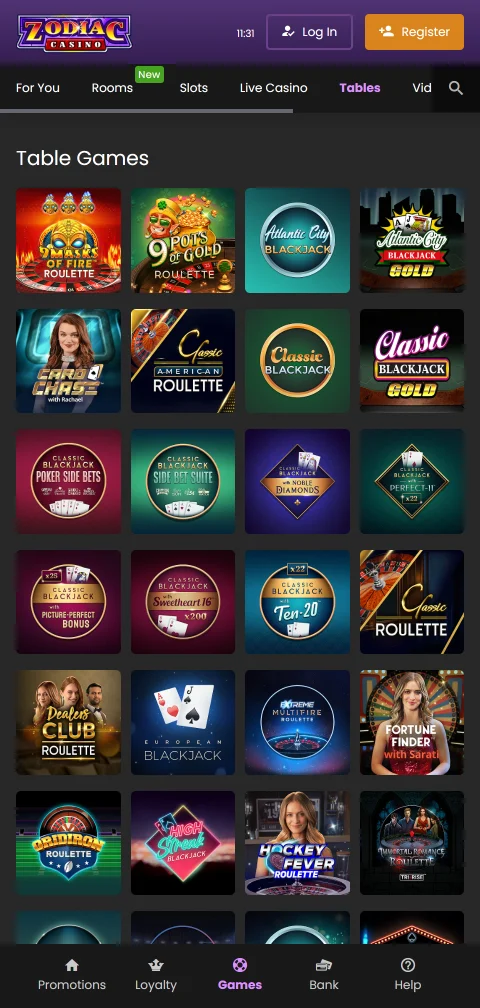
| Number of Games | Over 1,000 |
| Game Providers | Games Global (Microgaming) and partner studios |
| Payment Methods | Visa, Mastercard, bank transfer |
| Payment Services | Skrill, Neteller, Paysafecard |
| Mobile App | Mobile browser; check site for app download |
| VIP Programme | Casino Rewards, six levels |
| RTP | Approximately 96% on most slots |
| Licence | Kahnawake Gaming Commission, 00972 |
| Operator | Fresh Horizons Limited (Casino Rewards) |
| Launch Date | 2001 |
| Legal Age | 18+ |
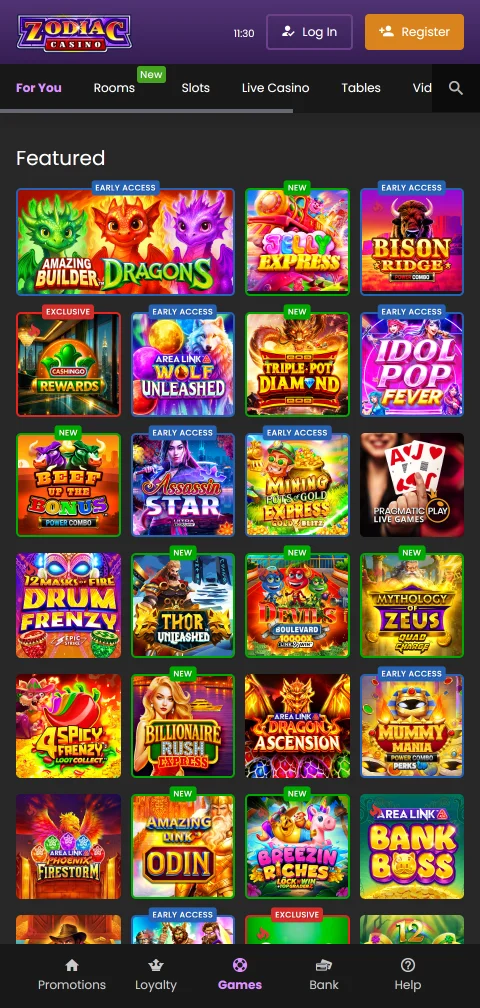
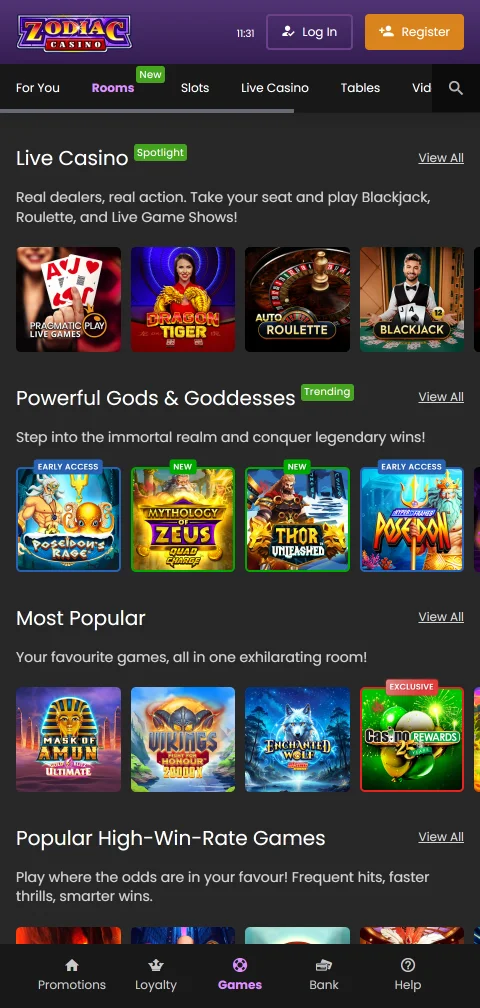
- A €1 first deposit buys 80 chances on the Mega Money Wheel jackpot game
- eCOGRA Safe and Fair certificate, with eCOGRA also named as the dispute service
- Loyalty points carry across every Casino Rewards sister site, so one balance serves several brands
- The first two welcome bonuses carry 200x wagering, which few players will ever clear
- Every withdrawal sits in a 48-hour pending period before processing even begins
Live chat runs 24/7, email takes written queries, and eCOGRA handles what agents cannot settle, as our Zodiac Casino support assessment sets out.
Jackpot City Casino review
| Key Feature | Four-part match bonus plus daily Million spins |
| Welcome Bonus | 100% up to €400 (part of €1,600 package) |
| Min. Deposit | €10 |
| Number of Games | Not published; approximately 450-600 |
| Game Providers | Games Global, Pragmatic Play, OnAir Entertainment |
| Payment Methods | Visa, Mastercard, Skrill, ecoPayz |
| Payment Services | Debit cards, e-wallets, bank transfer |
| Mobile App | No Irish app; mobile browser site |
| VIP Programme | Loyalty points programme |
| RTP | Typically around 95-97% per game |
| Licence | Kahnawake Gaming Commission (Baytree Interactive) |
| Operator | Baytree Interactive Limited (Guernsey) |
| Launch Date | 1998 |
| Legal Age | 18+ |


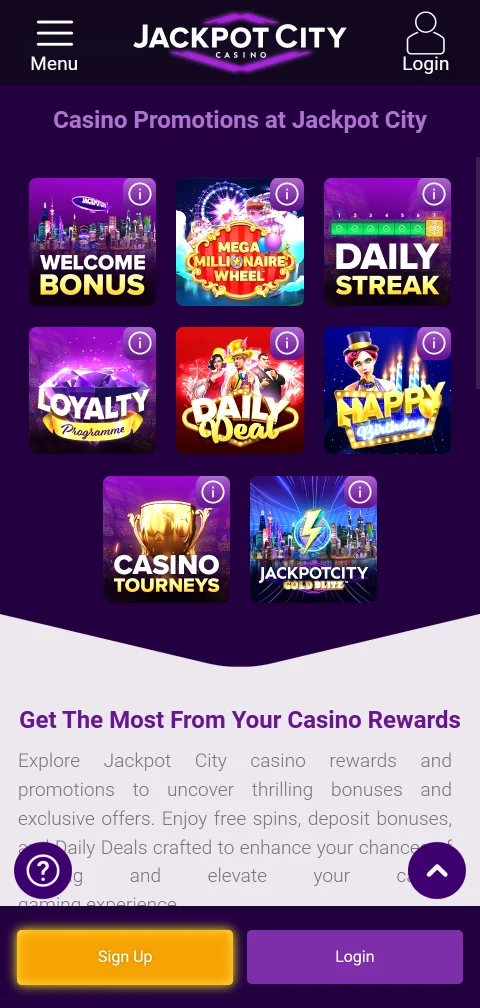
- Welcome package spreads up to €1,600 across four deposits, each starting from just €10
- Operating since 1998, with the Irish site listed on the Kahnawake permit-holders register
- Games Global jackpot slots including Mega Moolah, plus live tables from OnAir Entertainment
- No total game count is published, and the Irish lobby credits only three studios
- No GRAI licence yet and no native app for Irish players, only the mobile site
Live chat is listed 24/7, email replies take up to around 48 hours and there is no Irish phone line. The Jackpot City Casino support review covers what to ask when a first withdrawal stalls.
Spin Casino review
| Key Feature | Irish-facing site running since 2001 (as Spin Palace) |
| Welcome Bonus | 100% up to €400 on first deposit |
| Min. Deposit | €10 |
| Number of Games | Approximately 1,400 |
| Game Providers | Games Global, Pragmatic Play, Hacksaw Gaming, Spribe, Blueprint |
| Payment Methods | Visa, Mastercard, paysafecard, Skrill, NETELLER, MuchBetter |
| Payment Services | Swift bank transfer (withdrawals only) |
| Mobile App | Mobile browser site; app availability to check per store |
| VIP Programme | Loyalty scheme; tier details on the site |
| RTP | Typically 94-97% on slots |
| Licence | Offshore/international; check footer before depositing |
| Operator | Not confirmed; named in the site terms |
| Launch Date | 2001 |
| Legal Age | 18+ |


- Welcome offer is split €400, €300 and €300, so you can stop after one deposit
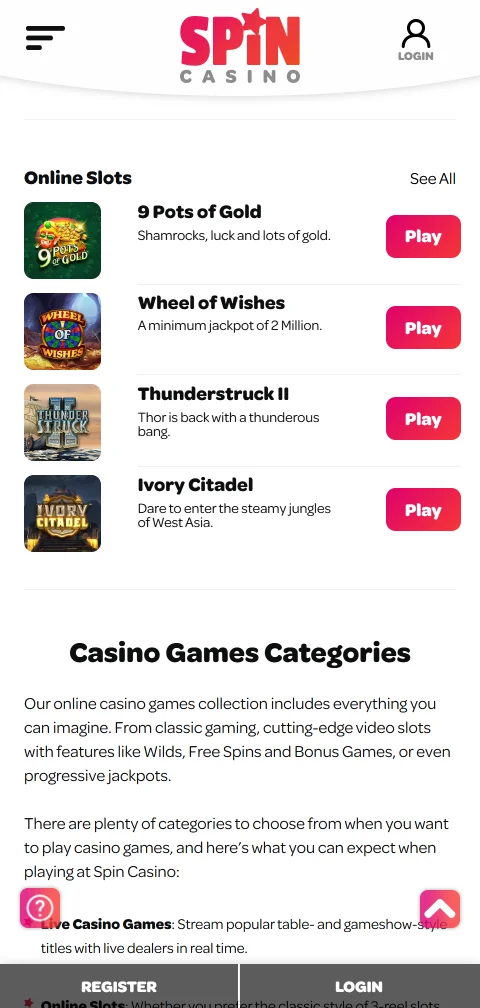
- Seven named studios on the Irish page, from Games Global to Hacksaw Gaming
- Six two-way payment rails listed for Ireland, with Swift added for withdrawals
- Brand history goes back to 2001, when it traded as Spin Palace
- Wagering reported by Irish reviewers at up to 70x, well above the 35x seen elsewhere
- Licence details are not shown on the Irish landing page we read
- No Irish GRAI gaming licence exists yet, so Irish complaint routes do not apply
Support is described as 24/7, with live chat and email as the usual channels and no phone number listed on the Irish page. Our Spin Casino editorial assessment covers what to ask.
Lucky Nugget Casino review
| Key Feature | Three-step welcome package from €1 |
| Welcome Bonus | 40 bonus spins for a €1 deposit |
| Min. Deposit | €1 (bonus step one), €5 for later steps |
| Number of Games | Approximately 500-700 titles |
| Game Providers | Games Global (Microgaming) catalogue, Evolution live tables (approx.) |
| Payment Methods | Visa Debit, Mastercard Debit, bank transfer |
| Payment Services | Skrill, Neteller, Neosurf, ecoPayz |
| Mobile App | Mobile browser site; app availability varies by region |
| VIP Programme | Loyalty points scheme (shared-platform style) |
| RTP | Approximately 95-97% across slots |
| Licence | Kahnawake Gaming Commission (per recent reviews; check footer) |
| Operator | Unconfirmed; check the site footer |
| Launch Date | Late 1990s (approximately) |
| Legal Age | 18+ |

- A €1 first deposit gets you 40 spins, a low entry point for a careful first visit.
- E-wallet withdrawals through Skrill or Neteller land in roughly 24-48 hours after the pending period.
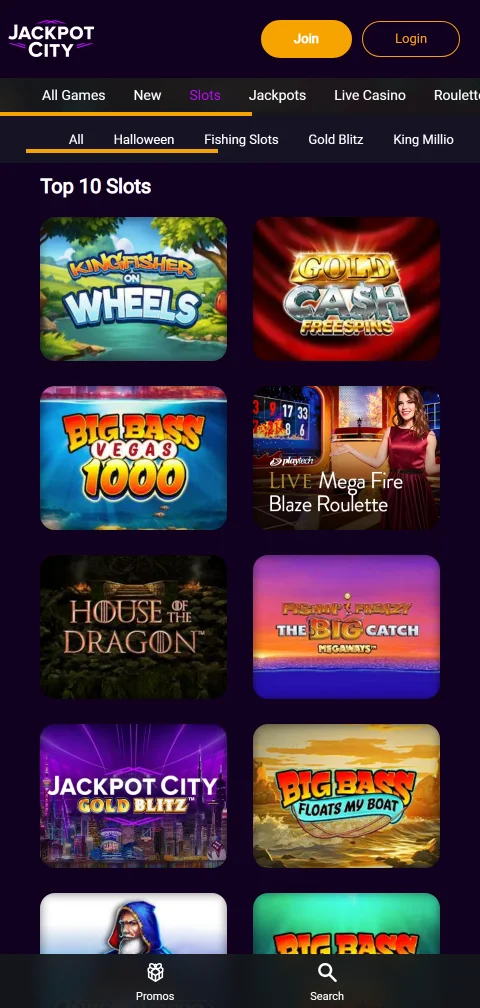
- A long-running Games Global catalogue, with Mega Moolah progressive jackpots tied into the welcome steps.
- Welcome terms reported at 200x wagering, far above the 35x-40x common at comparable sites.
- Minimum withdrawal of €50 is high, and no GRAI licence exists yet for Irish players.
Live chat and email, reported as 24/7, no Irish phone line, and a complaint route after about a week’s wait: Lucky Nugget support assessment.
LuckyDays Casino review
| Key Feature | Three-part welcome package with 25x wagering |
| Welcome Bonus | 100% up to €100 plus 100 free spins |
| Min. Deposit | €20 (up to €30 on some methods) |
| Number of Games | Over 3,300 |
| Game Providers | Play'n GO, Microgaming, NetEnt, Evolution, Pragmatic Play |
| Payment Methods | Visa, Mastercard, bank transfer, Paysafecard |
| Payment Services | Skrill, Neteller, MuchBetter |
| Mobile App | No native app; mobile browser site |
| VIP Programme | Loyalty rewards; terms on site |
| RTP | Approximately 96% average on slots |
| Licence | Curaçao (reported: 365/JAZ); verify on site |
| Operator | Raging Rhino N.V. |
| Launch Date | 2019 (some sources say 2018) |
| Legal Age | 18+ |

- Welcome package of up to €1,000 carries 25x wagering, lower than many offshore rivals
- Withdrawal requests are processed within 24 hours once your account is verified
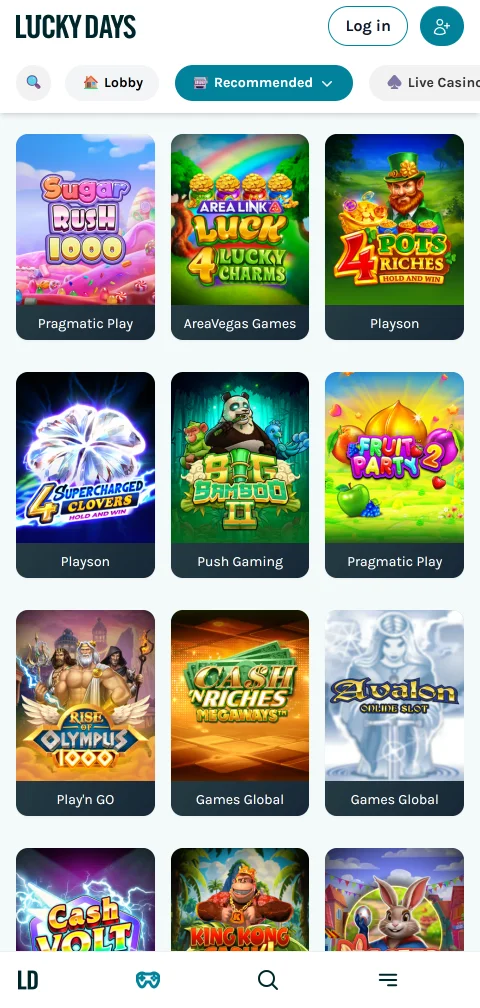
- Library of over 3,300 titles, with Book of Dead free spins tied to the first deposit
- Reported licence is Curaçao, not an Irish GRAI or other European regulator
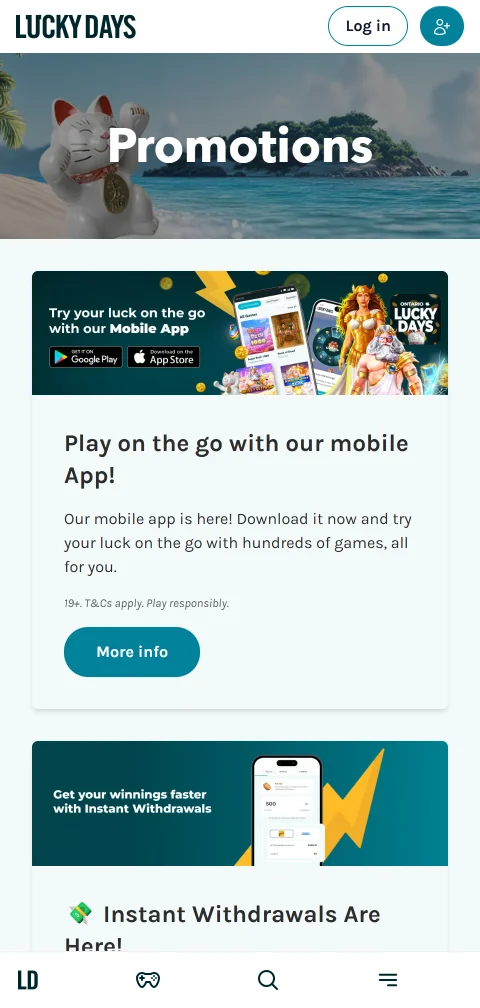
- No native app for Irish players, and the payment list for Ireland is not published openly
Live chat and email at [email protected], no phone line and unpublished chat hours for Ireland: support is assessed in the LuckyDays Casino support review, together with exactly how to chase a pending payout by stage.
How we placed the Kahnawake casinos on this list
The order below comes from reading each operator’s published terms, its authorisation on the Kahnawà:ke Gaming Commission register and the rules the Commission itself publishes. Commercial arrangements with operators do not move a placing, and an unverifiable licence claim removes a casino from consideration entirely.
Bonuses and how their terms sit with Irish rules
A placing rises when the wagering requirement, the maximum bet while wagering and the expiry period are all printed on one terms page in euro, and when wagering stays at or under 35 times the bonus. It falls where terms are only in a pop-up, where winnings are capped without the cap being stated, or where a bonus is tied to depositing again before a withdrawal.
Withdrawals, payment methods and the credit card ban
An operator that takes Irish credit cards for gambling sits badly with the 2024 Act’s ban, even where its Kahnawake authorisation is silent on the point, so refusing them to Irish accounts raises a placing. So does a stated withdrawal window of 48 hours or less after approval. Weekly caps below €5,000, fees on standard withdrawals, or a pending period over 72 hours lower it.
Games, studios and certification
Game studios whose own licences can be checked, and published RTP figures for the slots on offer, raise a placing. A library that leans on unnamed or uncertified providers lowers it, however large the game count looks, because an RTP figure from a studio nobody can trace tells the player nothing about the game they are actually spinning.
Mobile access and account controls
A placing rises when deposit limits, time-outs and self-exclusion can be set from the phone browser or app in the same account menu as the cashier, with no need to email support. It falls when those controls exist only on desktop or only on request, because a limit that takes a day to set is not one a player reaches for in the moment.
The Kahnawake authorisation and how it reads on the register
The first test is whether the operator’s company name and domain match an active Client Provider Authorization on the Commission’s own register, not just a seal in the footer. A matching company name in the terms and a stated route to the Commission for disputes raise a placing. A domain missing from the register, or a footer naming three regulators without saying which covers Irish players, lowers it sharply.
Support and the internal complaints step
Because the Commission expects a player to have tried the operator first, a published internal complaints procedure with a stated response time raises a placing, as does live chat staffed in English. Support reachable only through a contact form, or no written complaints policy at all, lowers it, since it leaves nothing to show the Commission later.

Checking a Kahnawake licence before you deposit
A footer badge proves nothing on its own, because it is an image and anyone can paste it onto a page. What carries weight is the entry on the Kahnawà:ke Gaming Commission’s register, which lists the operators holding a Client Provider Authorization, the permit the Commission issues to companies whose gaming operations are hosted in the Kahnawà:ke Mohawk Territory.
The register is public and free to search, and the check takes a few minutes if you know which names to compare.
The point most often missed is that the company named in the casino’s terms and conditions is the party the authorisation covers, so a domain that appears on the register under one company while its terms name a different one, perhaps a Cyprus or Curaçao entity that handles payments, needs a closer look before any money moves.
Six steps to verify a KGC authorisation
These are the checks the desk runs on every casino before it can appear on this list, in the order that saves the most time when one of them fails.
- Step 1
Find the operator's company name
Open the casino's terms and conditions and note the full legal name of the company running the site, together with its registered address and any licence number it quotes. - Step 2
Open the Commission's own register
Go to the Kahnawà:ke Gaming Commission website directly rather than through the casino's seal, and open the list of authorised client providers. - Step 3
Match the domain and the company
Confirm that the exact domain you intend to use appears under the same company name, since one authorisation can cover several domains but only those listed. - Step 4
Check the status is current
Make sure the entry is active and not marked as suspended or revoked; the Commission publishes notices when it takes action against an operator. - Step 5
Read which licence covers you
Where a site names several regulators, find the clause stating which licence applies to players in Ireland, because that decides where any complaint can go. - Step 6
Save copies of what you found
Keep a screenshot of the register entry and the relevant terms, dated, so a later complaint can show what the operator promised when you signed up.
What a Kahnawake licence covers and what it leaves out
The Kahnawà:ke Gaming Commission regulates interactive gaming under its Regulations concerning Interactive Gaming, and those Regulations set the conditions an authorised operator must meet on fair play, player funds, responsible gambling tools and dispute resolution. Part XXIV of the Regulations, sections 267 to 281, sets out the complaints process available to players of any authorised client provider.
What the authorisation does not do is make an operator subject to Irish law in any way an Irish player can enforce cheaply. A Kahnawake licence is a licence from a regulator in Canada, granted on the basis of where the servers are hosted, and it gives the Gambling Regulatory Authority of Ireland no standing over the operator unless that operator also holds a GRAI licence.
That distinction is the core of this page.
Kahnawake licences and the Irish register
The GRAI keeps its own register of licensed operators, and under the Gambling Regulation Act 2024 a business providing gambling to people in Ireland needs a licence from the Authority once the relevant sections have been commenced for that activity. Remote betting licences have been issued since 1 July 2026. For remote casino gaming, the desk found no commencement order and no gaming licences on the GRAI register when this page was last checked, which is why casino sites serving Irish players still hold their licences from abroad, from Malta, Curaçao or Kahnawà:ke, while that remains the case.
Kahnawake protection set against a GRAI licence
Readers often assume that a regulated casino is a regulated casino, wherever the licence was issued. The comparison below is there to correct that, row by row, using the published rules of each regulator rather than any operator’s marketing.
The GRAI’s complaints function was commenced by the order that took effect on 5 February 2026, and the Gambling (Complaints Procedures) Regulations 2026, S.I. No. 170/2026, set out the steps a complainant, a licensee and the Authority follow under Part 7 of the Act. None of that reaches an operator that holds only a Kahnawake authorisation.
Kahnawà:ke Gaming Commission | GRAI licence under the 2024 Act |
|---|---|
| Complaints accepted in writing, 7 days to 6 months after the issue arose | Complaint to the GRAI under Part 7, following S.I. No. 170/2026 |
| No Irish enforcement; sanctions limited to the Commission's own permit | Part 8 enforcement, including compliance agreements and investigations |
| Credit card ban applies only through the operator's own policy | Credit card payments prohibited for licence holders by the Act |
| Authorisation tied to hosting in the Kahnawà:ke Mohawk Territory | Licence tied to providing gambling to people in Ireland |
| Covers online casino games today | No remote gaming licence on the register when last checked |
Identity checks and source-of-funds requests
Anti-money-laundering checks are where a Kahnawake casino and its player most often fall out, and the dispute is usually about timing rather than about whether the check is lawful.
An authorised operator is expected to verify who its players are, so a request for photo identification and a recent proof of address before the first withdrawal is normal, and a casino asking for them is following its obligations rather than stalling. Where the request grows into a demand for bank statements, payslips or a source-of-funds declaration, the trigger is usually the size of the withdrawal or the pattern of deposits, and the operator is entitled to ask.
What a player can reasonably expect is that the terms say when verification happens, which documents are accepted and how long review takes. A casino that lets you deposit and play for weeks without any check, then asks for six months of statements only when you win, has written its terms to allow that, and the Commission’s complaints process will look at whether the operator followed its own published terms rather than whether those terms were generous.
So send the documents early, before the first deposit if the cashier allows it.
Licences Irish players meet on casino sites
The table sets out the four licences an Irish player is most likely to see in a casino footer, drawn from each regulator’s published framework. It shows who issues each one and what it means for a complaint from Ireland.
| Licence | Issued by | Based in | Player complaints | Irish enforcement |
|---|---|---|---|---|
| Client Provider Authorization | Kahnawà:ke Gaming Commission | Quebec, Canada | Written, 7 days to 6 months | None |
| B2C gaming licence | Malta Gaming Authority | Malta | MGA player support | None |
| Curaçao gaming licence | Curaçao Gaming Authority | Curaçao | Regulator's complaints form | None |
| Remote betting licence | GRAI | Ireland | Part 7 of the 2024 Act | Part 8 of the 2024 Act |
Taking a complaint to the Kahnawake Commission
The Commission’s route is written down and has fixed limits, which is more than some offshore regulators offer, but it begins only after the operator has had its chance.
Raise the problem with the casino first, in writing, and keep the replies. The Commission requires complaints in writing with clear details of who the complainant is, what happened and what steps were already taken with the operator, and it can be reached at [email protected] or through the form on its dispute resolution page.
Timing decides most cases before the merits do. A complaint must be lodged not less than 7 days and not more than 6 months after the matter first arose, the Commission states that it acknowledges complaints within 24 hours, and the operator is required to give a full response within 7 days unless the Commission directs otherwise. The Commission also says a complaint already discussed on a public forum, or already ruled on by another regulator, may jeopardise its ability to help, which matters for anyone tempted to post about a withheld payout before filing.
Unless the Commission decides otherwise, the operator is shown the complainant’s details.
Irish rules a foreign licence does not switch off
Since 5 February 2026, parts of the Gambling Regulation Act 2024 have been in force, including the ban on using credit cards to pay for gambling, and the Act also requires licence holders to give customers tools to set monetary limits on their accounts.
Those obligations bind GRAI licence holders. A casino operating on a Kahnawake authorisation alone is not a GRAI licensee, so the Authority’s enforcement powers do not reach it, and whether it accepts an Irish credit card is a question of its own policy rather than Irish supervision.
Treat that gap as a reason to set your own limits rather than as a loophole.
The inducement and advertising provisions of the Act follow the same logic: they constrain licensees, and where a section awaits a commencement order it binds nobody yet. Where this page could not confirm that a given section had been commenced, it says so rather than assuming it, and an operator’s claim to follow Irish rules voluntarily is worth only what its terms commit it to in writing.
Gambling with limits on a foreign-licensed site
A casino authorised in Kahnawà:ke is required by the Commission’s Regulations to offer responsible gambling measures, and the Commission publishes yearly summaries of player self-limitation and self-exclusion. Those tools only work if you use them, and on a site outside GRAI supervision there is no Irish regulator checking that they are offered in a form you can easily reach.
Set a deposit limit in the account menu before your first deposit, and decide on a loss figure you can afford for the month rather than for the session. If you self-exclude at one operator, remember that the exclusion covers that operator, not every other site under the same licence. Gambling is paid entertainment with a built-in house edge, never a way to make money, and help is available free and in confidence through the services listed below.
Before you rely on a Kahnawake licence
One condition would change this list overnight: the day the GRAI issues remote gaming licences, an Irish licence becomes available to casinos. Any operator on this page that stays on a Kahnawake authorisation alone will then have chosen to sit outside Irish enforcement. The register entries behind this list were last verified on 23 October 2026. Until that change, the order of work is simple: check the register, read the clause naming your licence, and keep your 6-month complaint window in mind.
Questions about Kahnawake licensed casinos
Is it legal to play at a Kahnawake licensed casino from Ireland?
The 2024 Act places its licensing duties on operators rather than players, so an Irish adult playing at a casino authorised by the Kahnawà:ke Gaming Commission is not committing an offence by doing so. The practical risk is different: if something goes wrong, the GRAI cannot act against an operator it has not licensed.
Who issues a Kahnawake licence?
The Kahnawà:ke Gaming Commission, a regulator based in the Kahnawà:ke Mohawk Territory near Montreal in Quebec. It issues a Client Provider Authorization to operators whose gaming is hosted in the Territory, and it keeps a public register of those operators on its own website.
Does a Kahnawake licence protect me like an Irish one?
No. A Kahnawake authorisation gives you the Commission’s own complaints process and nothing enforceable in Ireland, while a GRAI licensee is subject to complaints under Part 7 of the 2024 Act and enforcement under Part 8. The two are not equivalent, whatever a casino footer implies.
How long do I have to complain to the Commission?
The Commission accepts complaints no sooner than 7 days and no later than 6 months after the issue first arose. The complaint must be in writing, identify you clearly and describe the steps already taken with the operator, so contact the casino in writing before going to the regulator.
Why is a Kahnawake casino asking for my bank statements?
Anti-money-laundering rules allow an operator to ask where deposited money came from, usually when withdrawals are large or deposits follow an unusual pattern. Check the terms for which documents are accepted, send them in one batch, and keep a copy of everything you send and when.
Can a Kahnawake casino accept my Irish credit card?
The credit card ban in the 2024 Act binds GRAI licence holders, and it has been in force since 5 February 2026. A casino holding only a Kahnawake authorisation is outside that duty, so acceptance depends on its own policy, and the casinos on this list ranked higher where they refuse credit cards from Irish accounts.
More about online casinos






Compare the company named in each casino’s terms first, since that is the entity the register covers.