
































888 Casino review
| Key Feature | In-house 888 slots and table games |
| Welcome Bonus | 100% up to €500, 40x wagering |
| Min. Deposit | €10 |
| Number of Games | Approximately 2,000+ |
| Game Providers | 888 in-house studio, Evolution, NetEnt, Pragmatic Play (approx.) |
| Payment Methods | Visa, Mastercard, PayPal, Skrill, NETELLER, Paysafecard, bank transfer |
| Payment Services | Skrill, NETELLER, PayPal, MuchBetter |
| Mobile App | iOS and Android apps, plus browser |
| VIP Programme | Yes, invitation-based VIP Casino Club |
| RTP | Around 95-97% on most slots, varies by title |
| Licence | Gibraltar Remote Gaming Licence No. 112 |
| Operator | 888 Eire Limited (Gibraltar) |
| Launch Date | 1997 |
| Legal Age | 18+ |

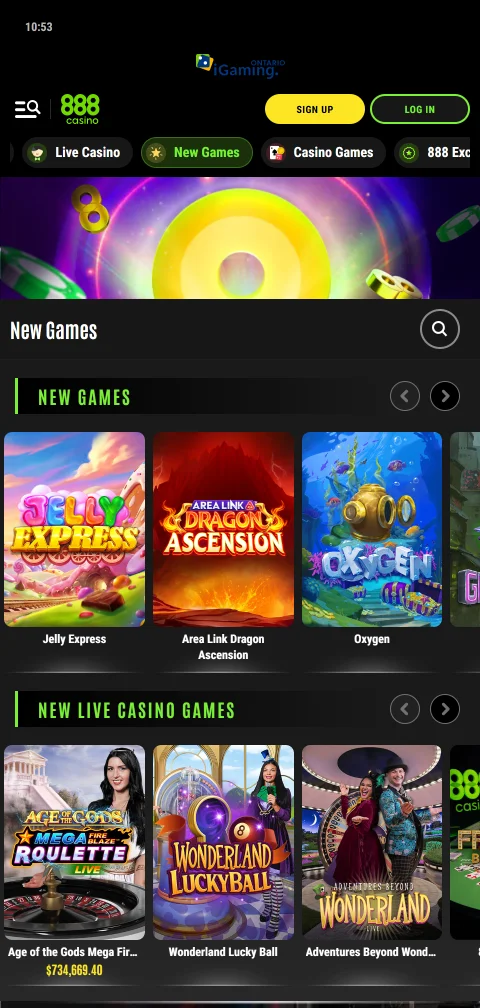

- Irish casino service licensed in Gibraltar under Remote Gaming Licence No. 112, named on every page
- Choice of welcome offers: 100% up to €500 or 100 free spins for a €10 deposit
- Operator history going back to 1997, with its own in-house slot and table studio
- Withdrawal timeframes published per method, including a one-day pending window for Gold VIP members
- Standard pending period of three business days before any withdrawal is processed
- 40x wagering on the match bonus, with Skrill and NETELLER deposits excluded from the offer
- Live chat only available while logged in and during operational hours, which are not published
The site runs over HTTPS, though no encryption standard or RNG testing lab is named; our 888 Casino security review explains what to ask.
bet365 Casino review
| Key Feature | One wallet shared with the bet365 sportsbook |
| Welcome Bonus | Up to 200 free spins over 10 days |
| Min. Deposit | €5–€10 depending on method |
| Number of Games | Approximately 1,500+ (unconfirmed) |
| Game Providers | Playtech, in-house titles and other studios (unconfirmed list) |
| Payment Methods | Visa Debit, Mastercard Debit, bank transfer, Trustly |
| Payment Services | PayPal, Apple Pay, Paysafecard |
| Mobile App | iOS and Android, casino inside main app |
| VIP Programme | No public VIP tiers published |
| RTP | Typically 94–97% on slots |
| Licence | GRAI remote betting; casino under MGA (check footer) |
| Operator | bet365 Group / Hillside entities |
| Launch Date | 2000 (bet365 brand) |
| Legal Age | 18+ |
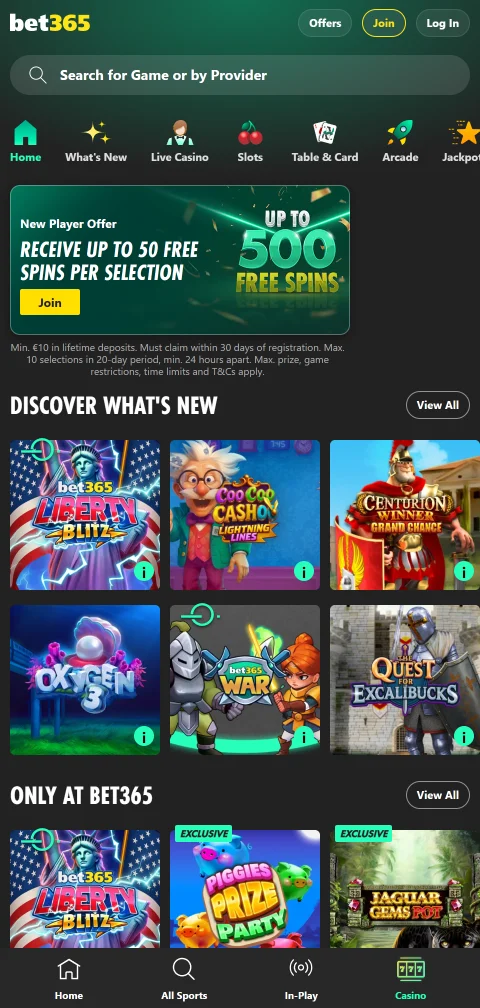
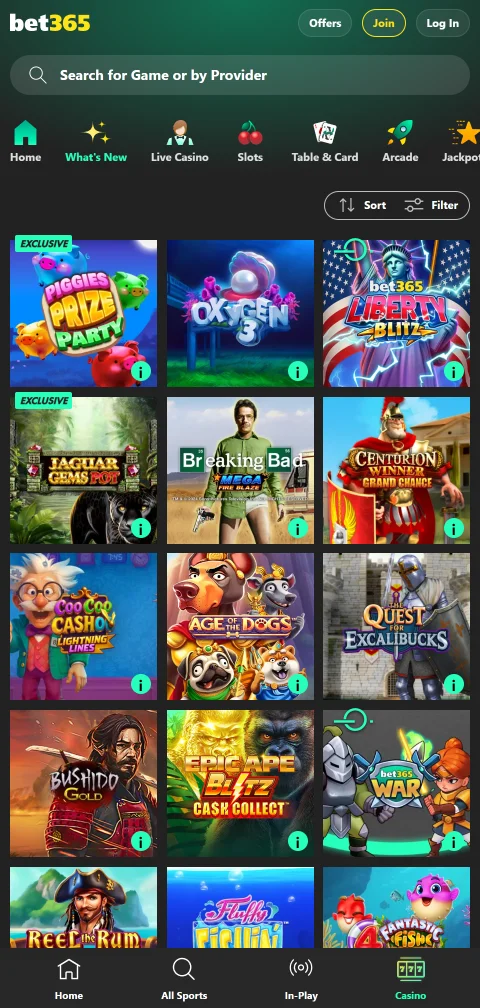

- Stated withdrawal processing target of around four hours, with Visa Direct possibly inside two
- No fees on any listed withdrawal method, with bank transfers up to €50,000
- Free spins welcome offer needs only €10 in lifetime deposits to qualify
- Holds a GRAI remote betting licence, listed on the public Irish register
- Casino, sportsbook and live dealer games share one balance and one login
- GRAI has not yet opened casino licences, so casino cover still relies on Malta
- Free spins prizes of 5, 10 or 20 are randomised, not a fixed amount
- Withdrawals must normally return to the deposit method, which is awkward to change
- No published VIP ladder or tiered loyalty scheme for casino players
bet365 names no encryption standard or audit body for its Irish casino, and KYC asks for photo ID plus proof of address before the first payout. Our bet365 Casino security review separates what is published from what is typical.
Betfair Casino review
| Key Feature | Casino, sportsbook and Exchange on one account |
| Welcome Bonus | €2 free bonus, 1x wagering, 7 days |
| Min. Deposit | €5 via Pay by Bank; €20 standard transfer |
| Number of Games | Approximately 1,000+ titles |
| Game Providers | Blueprint (Jackpot King), Evolution, others |
| Payment Methods | Debit card, Pay by Bank, bank transfer, Apple Pay |
| Payment Services | Visa, Mastercard, Apple Pay, PayPal (typically) |
| Mobile App | iOS and Android apps, plus browser |
| VIP Programme | No public VIP scheme confirmed |
| RTP | Typically 94-97% on slots |
| Licence | GRAI (betting); MGA/CRP/131/2006 (gaming) |
| Operator | Flutter Entertainment plc group |
| Launch Date | Betfair brand founded 1999 |
| Legal Age | 18+ |
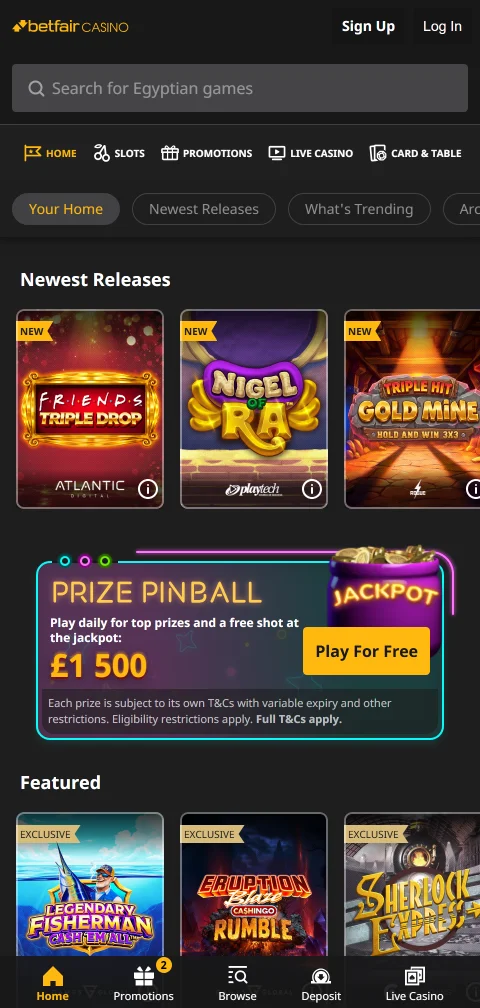


- Licence entities and numbers listed on a public regulatory information page, not buried in terms
- Pay by Bank withdrawals are stated at 1-4 hours, with a €5 minimum
- The €2 free bonus carries only 1x wagering, which is unusually light
- The Irish casino welcome offer is small next to the sportsbook and UK casino deals
- Standard bank transfers take 1-5 days and need a €20 minimum deposit
Read our Betfair Casino security review for the published licence numbers, standard HTTPS and the absence of a named RNG audit body.
William Hill Casino review
| Key Feature | One account for sportsbook, Vegas, poker and bingo |
| Welcome Bonus | 200 free spins on Big William Hill Fortune for a €10 stake |
| Min. Deposit | Typically around €5-€10 depending on method |
| Number of Games | Approximately 1,700-2,000 |
| Game Providers | Playtech, Games Global, Red Tiger, ELK Studios, Pragmatic Play |
| Payment Methods | Visa, Mastercard, bank transfer, Apple Pay, PayPal |
| Payment Services | Visa Direct, PayPal, Skrill, Neteller, Paysafecard |
| Mobile App | iOS and Android (Vegas app) |
| VIP Programme | No public tiered VIP scheme confirmed |
| RTP | Typically around 94-97% per slot |
| Licence | Gibraltar Remote Gaming Licence 112 (casino); GRAI-1096-RB-26-0001 (sportsbook) |
| Operator | WH Ireland Limited (Evoke plc group) |
| Launch Date | 1934 (brand); online casino since the late 1990s |
| Legal Age | 18+ |



- Casino operated under Gibraltar Remote Gaming Licence 112, with the operator named in every footer
- Visa Direct card withdrawals stated at up to four hours, weekends included
- Support runs 24/7 through Messaging, and one login covers sportsbook, Vegas, poker and bingo
- Free spin winnings are capped at €30 and unused spins disappear after 24 hours
- Casino side is not yet licensed by the Irish regulator; no phone line confirmed for Irish players
Operated by WH Ireland Limited under licence 112. No encryption standard or testing body is published, as our William Hill Casino security review records.
Betway Casino review
| Key Feature | Casino and sportsbook on one wallet |
| Welcome Bonus | Up to €50 free bet + 50 bonus spins |
| Min. Deposit | €5 (debit card, for the welcome offer) |
| Number of Games | Approximately 500+ slots, plus tables and live |
| Game Providers | Games Global, NetEnt, Pragmatic Play; Evolution live |
| Payment Methods | Visa, Mastercard debit, open banking, e-wallets |
| Payment Services | Debit cards, PayPal, open banking |
| Mobile App | iOS and Android apps, plus browser |
| VIP Programme | Invitation-only; no public tier table |
| RTP | Typically 94-97% on slots |
| Licence | MGA/B2C/130/2006; GRAI licence (betting) |
| Operator | Betway Limited (Malta) |
| Launch Date | 2006 |
| Legal Age | 18+ |
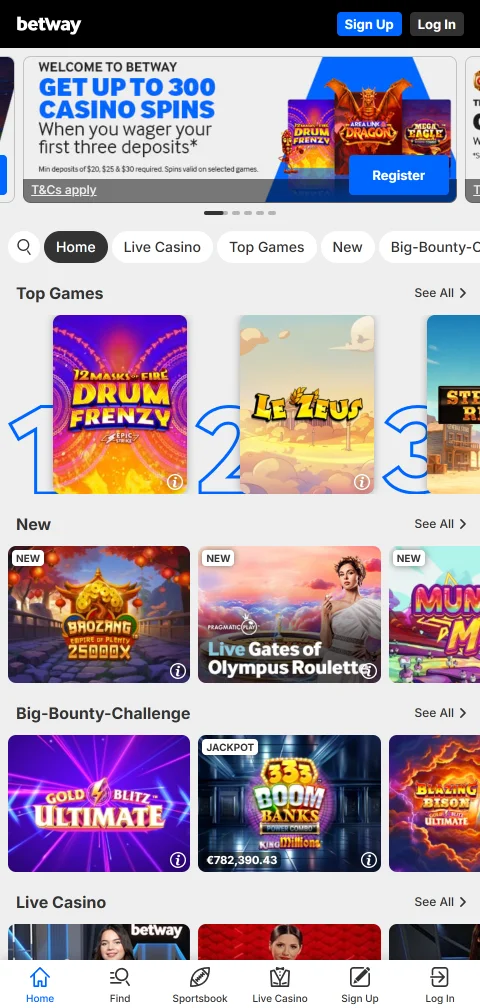
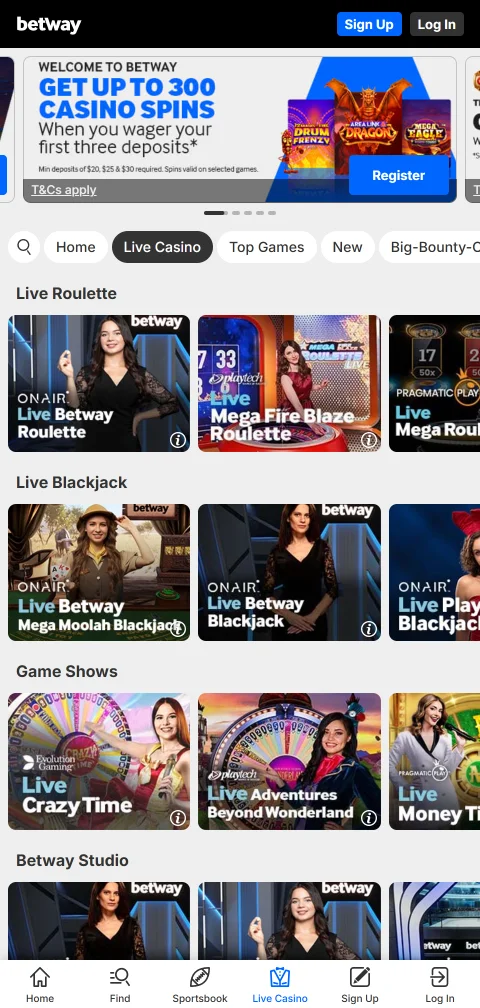
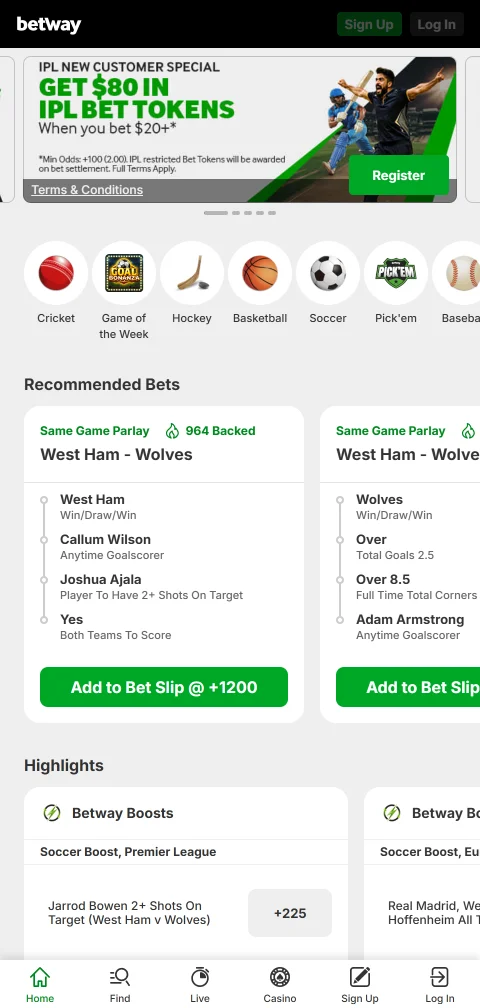
- Malta Gaming Authority licence MGA/B2C/130/2006 covers the casino product for Irish players
- GRAI register lists Betway for remote sports betting since the July 2026 licensing round
- Stated withdrawal processing within 24 hours, with one to two days in total
- Welcome offer starts from a €5 debit card deposit, lower than many rivals
- Bonus spins carry 50x wagering, and the offer expires seven days after registration
- Free bet returns winnings only; the €50 stake itself is never paid back
- Ireland has no online casino licence yet, so casino play relies on Malta
TLS encryption on the cashier and no named testing laboratory: the Betway Casino security check states what is published and what is not.
How we rate blackjack casinos
The ranking is built from what each casino publishes: the rules shown at each blackjack table, the bonus terms that mention table games, the licence on record and the stated payout windows. Commission, logo size and the headline bonus figure do not move a placing.
Blackjack bonuses and their terms
An offer that counts blackjack toward wagering at 10% or more, stated in the terms, raises a placing. A bonus that quietly sets blackjack at 0% while advertising table games lowers one.
Withdrawals and payment methods
A stated withdrawal window of 24 hours or less on cards and e-wallets raises a placing, as does a published processing time for bank transfer to an Irish account. A pending period of 72 hours or more, fees on withdrawals, or a manual review promised on every cash-out lowers a placing, whatever the deposit side looks like.
Blackjack tables and their providers
We count tables that pay 3:2 and show their full rules before a hand is dealt: soft 17, deck count, doubling and splitting. A lobby where most RNG tables pay 3:2 from studios that publish RTP raises a placing. One dominated by 6:5 tables, or by hidden rules, lowers it.
Mobile tables and the lobby layout
A mobile lobby that filters blackjack by type and keeps the rules panel one tap away raises a placing. Live tables that hide their bet limits on a small screen lower one.
Licence details and game certification
A licence that can be found on the regulator’s public register, with RNG certificates from a named lab such as eCOGRA, GLI or iTech Labs, raises a placing. A licence number that leads nowhere, or certificates claimed without any document behind them, sends a casino to the bottom, since every other figure depends on this one.
Support and how reachable it is
Live chat available around the clock, staff who can answer a rules question about a specific table, and a stated email response time all raise a placing. Support limited to a contact form, or answers that only repeat the FAQ, lower one.

What actually sets the house edge in blackjack
The house edge is the share of each stake the casino expects to keep over a very long run of hands, and in blackjack it is not a fixed property of the game. It comes from the rules printed at a particular table, combined with how well the player follows the mathematically correct decision on each hand. Change one rule and the figure moves.
A typical six-deck game that pays 3:2 on blackjack, has the dealer stand on soft 17 and allows doubling after a split carries a house edge of roughly 0.4% to 0.5% against a player using basic strategy. Basic strategy is the table of correct decisions, hit, stand, double, split or surrender, for every combination of player hand and dealer upcard. Played on instinct instead, the same game commonly costs two percent or more, because the player’s errors give away far more than any rule does.
A worked example makes the scale clearer. Suppose someone stakes €500 in total across an evening at a 0.5% table. The long-run expectation is a loss of about €2.50, but that is an average over many thousands of such evenings, never a forecast for one of them. On any single night the result can swing by a hundred euro either way, and that swing tells you nothing about the rules.
That is the idea behind this whole page.
The RTP, or return to player, is simply the other side of the same number: a 0.5% house edge means a theoretical RTP of 99.5%. When a studio publishes an RTP for a blackjack title, it normally assumes perfect basic strategy, so the figure on the info screen describes a player who never makes a mistake. Where a provider does not state the assumption, we treat the RTP as unconfirmed rather than guess at it.
It also helps to separate the edge from volatility, the size of the swings around that average. Blackjack has fairly low volatility for a casino game, but doubling and splitting put extra money on the table at exactly the moments the maths favours the player, so short sessions still produce results that look nothing like 0.5%. Over €500 of stakes, a loss of €40 or a win of €60 are both ordinary outcomes, and neither says the table is generous or mean.
Why a 3:2 payout matters more than any bonus
A natural blackjack, an ace with a ten-value card as the first two cards, arrives in roughly one hand in twenty-one. At a 3:2 table it pays €15 on a €10 bet; at a 6:5 table it pays €12. That €3 gap looks small, and on any one hand it is.
Spread across every hand played, though, the reduced payout adds about 1.4 percentage points to the house edge, which is more than the combined effect of most of the other rule changes a casino can make. A game that sat at 0.5% becomes a game near 1.9%, and no amount of careful strategy recovers that ground.
The 6:5 version is far more common in land-based casinos than online, but it does turn up in some RNG lobbies and on a number of novelty variants. It is usually marked only in small print on the felt or in the rules panel, so we read the panel on each table rather than assuming the lobby is consistent.
The basic strategy decisions themselves do not change between the two payouts, which is why the 6:5 version can feel like the same game. It is the same game, priced differently.
3:2 blackjack table | 6:5 blackjack table |
|---|---|
| Pays €15 on a €10 natural | Pays €12 on a €10 natural |
| House edge near 0.5% with basic strategy | House edge near 1.9% on the same rules |
| Basic strategy decisions unchanged | Basic strategy decisions unchanged |
| Standard on most online RNG and live tables | Mostly found on novelty and some RNG variants |
Dealer rules, doubling and surrender explained
After the payout ratio, the rules that move the edge most are about what the dealer must do and what the player is allowed to do. Each one is a small number, but they stack, and a table with several unfavourable rules can quietly double its edge.
Soft 17
A soft 17 is a hand of 17 that contains an ace counted as eleven, such as ace and six. When the dealer must hit it rather than stand, the house edge rises by about 0.2%, because the dealer gets an extra chance to improve a weak total. Tables label this as H17 or S17, or spell it out as “dealer stands on all 17s”.
Doubling and splitting
Doubling down means doubling the stake in exchange for exactly one more card. Tables that restrict it to totals of 9, 10 and 11, or to 10 and 11 only, take away profitable doubles on soft hands and cost the player roughly 0.1% to 0.2%. Refusing a double after a split adds about another 0.14%, and a limit on re-splitting aces costs a little more again.
Surrender and deck count
Late surrender lets a player give up half the stake after the dealer has checked for blackjack, and when it is used correctly it trims the edge by a few hundredths of a percent. The number of decks matters less than many players believe: moving from six decks to eight adds only a couple of hundredths. A single-deck game is better on paper, though online single-deck tables often pair it with a 6:5 payout, which more than cancels the gain.
The figures in this section are standard published approximations for multi-deck games with otherwise typical rules, and the exact value at any one table depends on the full combination.
Reading a blackjack table before you play
Most online blackjack tables, RNG and live alike, carry an information or help screen that lists the rules and, in many cases, the theoretical RTP. Reading it takes a minute and settles more than any review can, since a casino can host several versions of the same title side by side.
The habit that matters is checking the specific table, not the game name. Two tables both called “Classic Blackjack” from different studios can have different dealer rules and different payouts, and a studio can release one title in more than one configuration for different operators.
How to check a blackjack table's rules
The sequence below is the order the desk follows on every table it lists, and it works the same way on a phone as on a laptop.
- Step 1
Open the help or info screen
Look for the question mark or 'i' icon inside the game. It lists the rules for that exact table, which can differ from another table with the same name in the lobby. - Step 2
Confirm blackjack pays three to two
Find the payout line for a natural. It should read 3:2 or 'pays 1.5 times the stake'. If it reads 6:5, the table costs roughly 1.4% more than an equivalent 3:2 game. - Step 3
Check what the dealer does on soft 17
Look for S17, 'dealer stands on soft 17' or 'dealer stands on all 17s'. A table where the dealer hits soft 17 adds about 0.2% to the edge. - Step 4
Note doubling, splitting and surrender rules
Check whether doubling is allowed on any two cards, whether you may double after splitting, how often aces can be split and whether late surrender is offered. - Step 5
Read the stated RTP and its assumption
If the screen shows an RTP, check whether it assumes optimal strategy. Without that assumption stated, treat the number as a description of perfect play rather than a promise about yours.
Live dealer blackjack and RNG tables compared
RNG blackjack is dealt by a random number generator, software that produces card sequences which independent labs test for fairness. Most RNG tables shuffle a fresh virtual shoe after every hand, which is why counting cards against them achieves nothing at all.
Live dealer blackjack streams a real dealer and a real shoe from a studio. The rules are often similar to RNG games, typically eight decks, 3:2 and the dealer standing on soft 17, but the shoe is cut well before the end and reshuffled, which removes most of the information a card counter would need. The practical differences lie elsewhere: live tables run at a set pace of perhaps a few dozen hands an hour, have higher minimum stakes and frequently fill up, while RNG tables let a player choose the pace and usually accept much smaller bets.
Pace has a direct cost that many players miss. The house edge applies per hand, so a fast RNG table at the same edge as a live one will consume a bankroll faster simply because more hands are dealt in the same hour.
Several live formats, often marketed as “infinite” or “unlimited” blackjack, let any number of players act on one shared hand, and some of these change the rules, for example paying a different amount when a player’s total ties certain dealer hands. Those rules are listed in the help screen and are worth reading as carefully as any RNG table’s.
Side bets and where the edge rises
Side bets such as Perfect Pairs, 21+3 and Bust It sit beside the main wager and pay on specific card combinations. They are separate games bolted onto the table, and their house edge is set by their own pay tables, which vary by studio and sometimes by operator.
Published pay tables for common versions put these bets at house edges of several percent, frequently between 3% and 7%, and some versions sit higher still. That is many times the edge on the main hand played with basic strategy.
So a player who adds a €1 side bet to every €10 main bet may find that most of the expected cost of the session comes from the side bet, not from blackjack itself. Where a table states the RTP of its side bets, we note it; where it does not, the figure is unconfirmed and we say so rather than borrow one from a different version.
How common rule changes move the edge
The table sets out typical published effects of individual rule changes against a standard six-deck, 3:2 game where the dealer stands on soft 17. The values are rounded approximations and they combine roughly additively.
| Rule change | Effect on edge | Where to look |
|---|---|---|
| Blackjack pays 6:5 | About +1.4% | Payout line |
| Dealer hits soft 17 | About +0.2% | H17 or S17 note |
| No double after split | About +0.14% | Splitting rules |
| Double on 10-11 only | About +0.2% | Doubling rules |
| Eight decks, not six | About +0.02% | Deck count |
| Late surrender offered | About -0.07% | Surrender option |
Blackjack and bonus wagering contributions
Wagering is the amount a player must stake before bonus funds become withdrawable, and contribution is the share of each table-game stake that counts toward it. Many casinos set blackjack at 10% or 20%, some at 0%, and slots usually at 100%.
The arithmetic decides whether a bonus is worth taking for a blackjack player. Take a €100 bonus with 35 times wagering, so €3,500 must be staked. At a 10% contribution, that means €35,000 of blackjack hands, and at a 0.5% edge the expected cost of all that play is about €175, which exceeds the bonus itself. At 100% contribution the same play would cost around €17.50, and the bonus would be worth having.
Terms also often cap the stake per hand while a bonus is active, commonly at a few euro, and some exclude doubling or splitting from counting. Breaking those clauses can void winnings, so we read the full bonus terms, not the summary banner, before an offer affects a placing.
A bonus that excludes blackjack is not a problem in itself; a bonus that hides the exclusion is.
Blackjack myths that cost players money
The most persistent myth is that a run of losing hands means a win is due. On a table that reshuffles after every hand, each deal is independent of the last, so ten losses in a row change nothing about the next hand. Even with a shoe dealt down partway, the effect of past cards is tiny and depends on which cards went, not on whether the player won.
A second myth is that betting systems, doubling after a loss in the style of the Martingale, can overcome the edge. They change the shape of results, many small wins and an occasional very large loss, but the expected cost per euro staked remains whatever the rules dictate. Table maximums and bankroll limits make the large loss arrive sooner than players expect.
A third is that insurance protects a good hand. Insurance is a side bet that the dealer holds blackjack, and without counting cards it carries a house edge of around 7% in a multi-deck game, which is why basic strategy says to decline it every time, even with 20 in front of you.
One session proves nothing about a table.
Finally, players sometimes conclude from a bad evening that an online game is rigged. A single session is far too short to measure an edge of half a percent; distinguishing a fair table from a slightly unfair one takes hundreds of thousands of hands, which is precisely the testing that labs such as eCOGRA, GLI and iTech Labs perform on RNG software. That is why we check for certificates from a named lab rather than relying on anyone’s run of luck.
Playing blackjack within your limits
A low house edge makes blackjack cheaper per hand than most casino games, but it does not make it a way to earn money, and every session has an expected cost. Decide on a budget before opening a table and treat it as the price of the evening, not as a stake to be won back. Deposit limits, session reminders and time-outs are available in the account settings of licensed casinos, and they work best when set before play rather than during it. Fast RNG tables deal many hands an hour, so the time limit matters as much as the money limit. If gambling stops being enjoyable, or you find yourself chasing losses, self-exclusion is available, and the support organisations listed below offer free, confidential help.
What to check before your next blackjack hand
The listing above reflects table rules and bonus terms as they stood when they were last re-read on 25 September 2026, and a casino’s placing would drop if its lobby moved toward 6:5 tables or its terms stopped counting blackjack. What this page does not cover is advanced play: card counting, deviations from basic strategy and tournament formats are deliberately left out. For ordinary play, the order is simple: confirm 3:2, check soft 17, skip the side bets, and only then look at the bonus.
Online blackjack questions answered
What is a good house edge for online blackjack?
With basic strategy, a six- or eight-deck game paying 3:2, where the dealer stands on soft 17 and doubling after a split is allowed, sits at roughly 0.4% to 0.6%. A table near 2% has an unfavourable payout or several restrictive rules, and the rules panel will show which.
Is 6:5 blackjack worth playing?
On the numbers, rarely. Reducing the payout for a natural from 3:2 to 6:5 adds about 1.4 percentage points to the house edge, more than any other common rule change. If a 3:2 table at a similar stake is available, it is the cheaper game to play.
Can you count cards in online blackjack?
Not against RNG tables, which typically reshuffle a virtual shoe after every hand, so no information carries over. Live tables use real shoes but cut them early and reshuffle, which removes most of the advantage, and operators can restrict accounts they suspect of counting.
Is online blackjack legal in Ireland?
Irish adults can play at licensed online casinos. The Gambling Regulation Act 2024 created the Gambling Regulatory Authority of Ireland, which is taking over licensing from the older system. Until its online licences are issued, check the operator’s current licence on the relevant regulator’s public register.
Does the RTP shown on a blackjack game apply to me?
Usually only if you play perfect basic strategy. Studios calculate blackjack RTP assuming optimal decisions on every hand, so a player who stands on 16 against a ten, or takes insurance, gets a lower return than the screen shows.
Do blackjack side bets have worse odds?
Generally, yes. Common side bets such as Perfect Pairs and 21+3 carry house edges of several percent depending on the pay table, many times the edge on the main hand. Check the side bet’s own RTP in the help screen before adding it to every hand.
Why does blackjack count so little toward bonus wagering?
Because its low house edge lets players clear wagering cheaply. Casinos therefore set blackjack contribution at 10% or 20%, or exclude it, while slots count fully. Work out the total stake needed at the stated rate before accepting any bonus for blackjack.
Should I take insurance when the dealer shows an ace?
Basic strategy says no. Insurance is a separate bet that the dealer holds blackjack, and in a multi-deck game it carries a house edge of about 7%. It does not protect your hand; it simply adds a costlier wager to it.
More about online casinos







Compare the casinos above by their blackjack tables, not their bonus banners. A lobby where most RNG tables pay 3:2 matters more than a welcome offer that counts blackjack at 10%.