
































888 Casino review
| Key Feature | In-house 888 slots and table games |
| Welcome Bonus | 100% up to €500, 40x wagering |
| Min. Deposit | €10 |
| Number of Games | Approximately 2,000+ |
| Game Providers | 888 in-house studio, Evolution, NetEnt, Pragmatic Play (approx.) |
| Payment Methods | Visa, Mastercard, PayPal, Skrill, NETELLER, Paysafecard, bank transfer |
| Payment Services | Skrill, NETELLER, PayPal, MuchBetter |
| Mobile App | iOS and Android apps, plus browser |
| VIP Programme | Yes, invitation-based VIP Casino Club |
| RTP | Around 95-97% on most slots, varies by title |
| Licence | Gibraltar Remote Gaming Licence No. 112 |
| Operator | 888 Eire Limited (Gibraltar) |
| Launch Date | 1997 |
| Legal Age | 18+ |

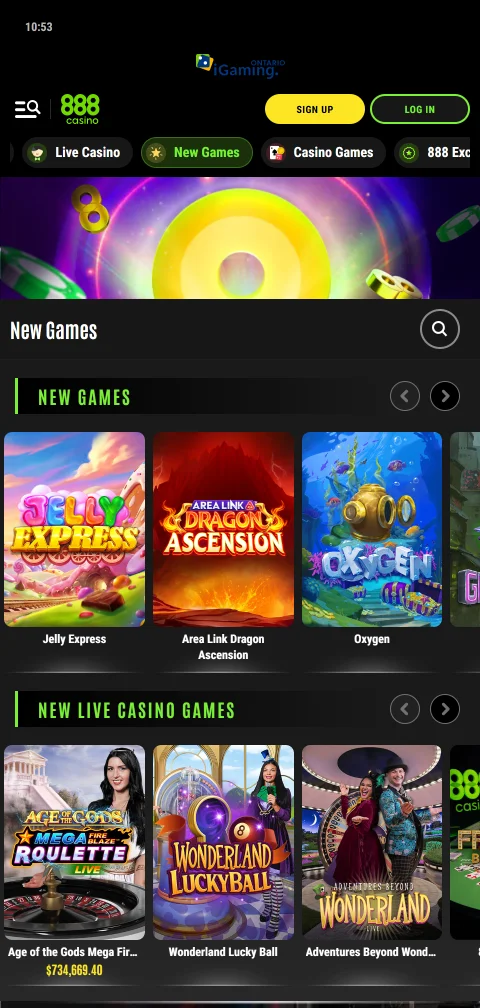

- Irish casino service licensed in Gibraltar under Remote Gaming Licence No. 112, named on every page
- Choice of welcome offers: 100% up to €500 or 100 free spins for a €10 deposit
- Operator history going back to 1997, with its own in-house slot and table studio
- Withdrawal timeframes published per method, including a one-day pending window for Gold VIP members
- Standard pending period of three business days before any withdrawal is processed
- 40x wagering on the match bonus, with Skrill and NETELLER deposits excluded from the offer
- Live chat only available while logged in and during operational hours, which are not published
Withdrawals wait three business days pending, then take 4-5 business days in total on Skrill and NETELLER, up to 10 by wire, as our 888 Casino payments analysis details.
bet365 Casino review
| Key Feature | One wallet shared with the bet365 sportsbook |
| Welcome Bonus | Up to 200 free spins over 10 days |
| Min. Deposit | €5–€10 depending on method |
| Number of Games | Approximately 1,500+ (unconfirmed) |
| Game Providers | Playtech, in-house titles and other studios (unconfirmed list) |
| Payment Methods | Visa Debit, Mastercard Debit, bank transfer, Trustly |
| Payment Services | PayPal, Apple Pay, Paysafecard |
| Mobile App | iOS and Android, casino inside main app |
| VIP Programme | No public VIP tiers published |
| RTP | Typically 94–97% on slots |
| Licence | GRAI remote betting; casino under MGA (check footer) |
| Operator | bet365 Group / Hillside entities |
| Launch Date | 2000 (bet365 brand) |
| Legal Age | 18+ |
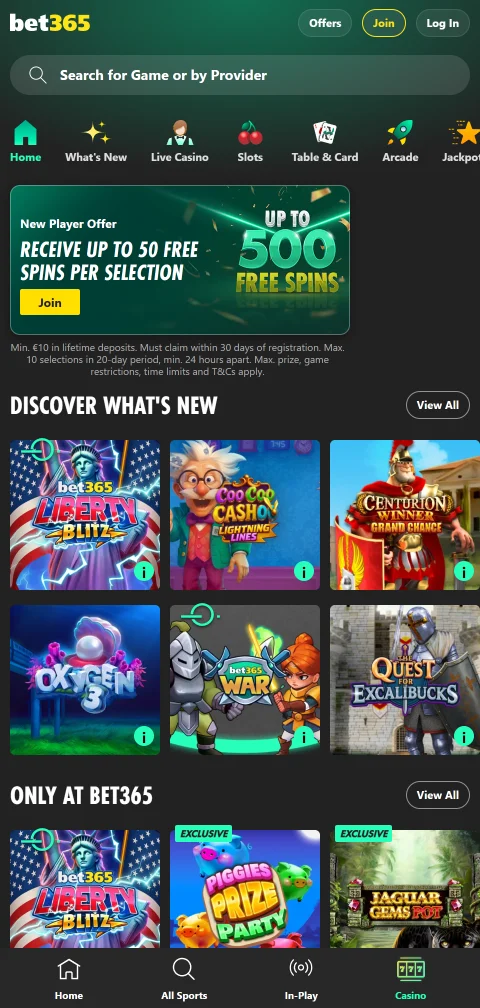
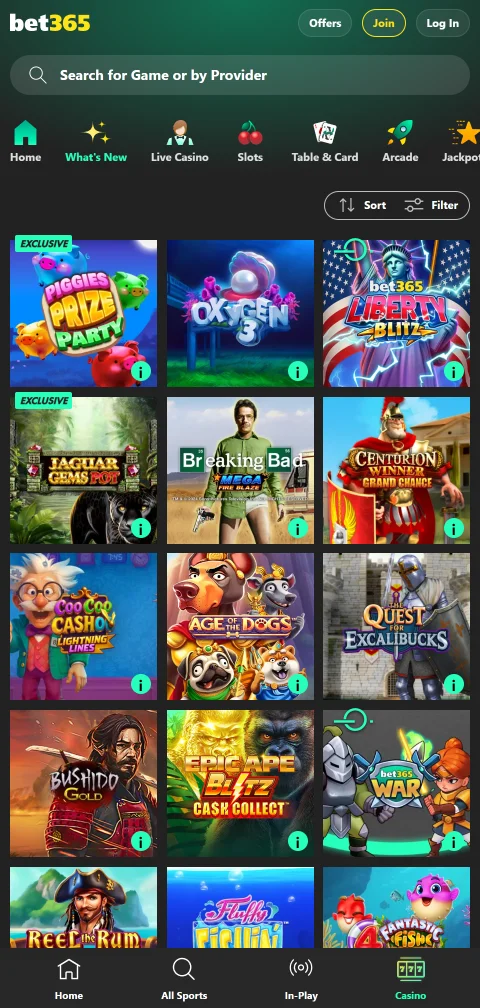

- Stated withdrawal processing target of around four hours, with Visa Direct possibly inside two
- No fees on any listed withdrawal method, with bank transfers up to €50,000
- Free spins welcome offer needs only €10 in lifetime deposits to qualify
- Holds a GRAI remote betting licence, listed on the public Irish register
- Casino, sportsbook and live dealer games share one balance and one login
- GRAI has not yet opened casino licences, so casino cover still relies on Malta
- Free spins prizes of 5, 10 or 20 are randomised, not a fixed amount
- Withdrawals must normally return to the deposit method, which is awkward to change
- No published VIP ladder or tiered loyalty scheme for casino players
Withdrawals processed within around four hours, no listed fees, and bank transfers up to €50,000: the bet365 Casino payments review details each method.
Betfair Casino review
| Key Feature | Casino, sportsbook and Exchange on one account |
| Welcome Bonus | €2 free bonus, 1x wagering, 7 days |
| Min. Deposit | €5 via Pay by Bank; €20 standard transfer |
| Number of Games | Approximately 1,000+ titles |
| Game Providers | Blueprint (Jackpot King), Evolution, others |
| Payment Methods | Debit card, Pay by Bank, bank transfer, Apple Pay |
| Payment Services | Visa, Mastercard, Apple Pay, PayPal (typically) |
| Mobile App | iOS and Android apps, plus browser |
| VIP Programme | No public VIP scheme confirmed |
| RTP | Typically 94-97% on slots |
| Licence | GRAI (betting); MGA/CRP/131/2006 (gaming) |
| Operator | Flutter Entertainment plc group |
| Launch Date | Betfair brand founded 1999 |
| Legal Age | 18+ |
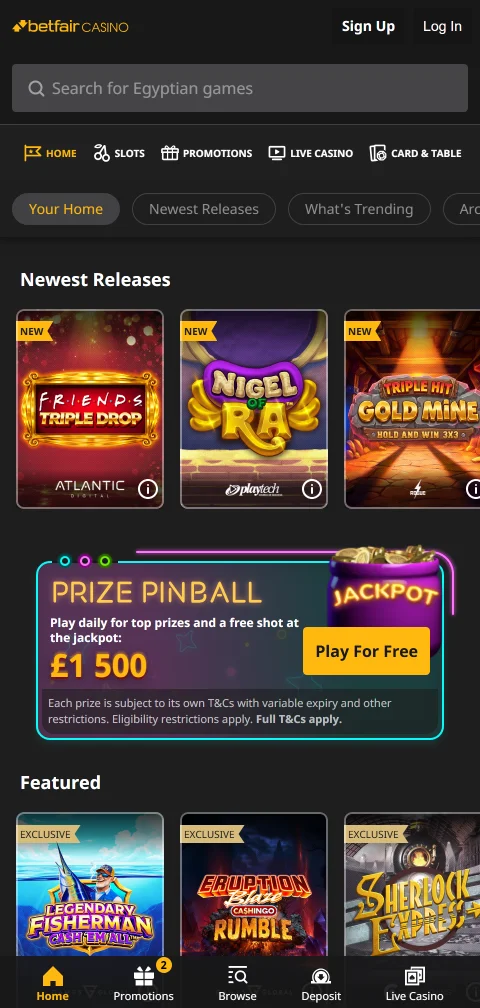


- Licence entities and numbers listed on a public regulatory information page, not buried in terms
- Pay by Bank withdrawals are stated at 1-4 hours, with a €5 minimum
- The €2 free bonus carries only 1x wagering, which is unusually light
- The Irish casino welcome offer is small next to the sportsbook and UK casino deals
- Standard bank transfers take 1-5 days and need a €20 minimum deposit
Pay by Bank withdrawals stated at 1-4 hours, standard transfers at 1-5 days, and a €5 minimum both ways: the Betfair Casino payments analysis sets out each rail.
William Hill Casino review
| Key Feature | One account for sportsbook, Vegas, poker and bingo |
| Welcome Bonus | 200 free spins on Big William Hill Fortune for a €10 stake |
| Min. Deposit | Typically around €5-€10 depending on method |
| Number of Games | Approximately 1,700-2,000 |
| Game Providers | Playtech, Games Global, Red Tiger, ELK Studios, Pragmatic Play |
| Payment Methods | Visa, Mastercard, bank transfer, Apple Pay, PayPal |
| Payment Services | Visa Direct, PayPal, Skrill, Neteller, Paysafecard |
| Mobile App | iOS and Android (Vegas app) |
| VIP Programme | No public tiered VIP scheme confirmed |
| RTP | Typically around 94-97% per slot |
| Licence | Gibraltar Remote Gaming Licence 112 (casino); GRAI-1096-RB-26-0001 (sportsbook) |
| Operator | WH Ireland Limited (Evoke plc group) |
| Launch Date | 1934 (brand); online casino since the late 1990s |
| Legal Age | 18+ |



- Casino operated under Gibraltar Remote Gaming Licence 112, with the operator named in every footer
- Visa Direct card withdrawals stated at up to four hours, weekends included
- Support runs 24/7 through Messaging, and one login covers sportsbook, Vegas, poker and bingo
- Free spin winnings are capped at €30 and unused spins disappear after 24 hours
- Casino side is not yet licensed by the Irish regulator; no phone line confirmed for Irish players
Visa Direct withdrawals within about four hours, other cards in 1 to 3 working days: the William Hill Casino payments analysis reads the stated rules.
Betway Casino review
| Key Feature | Casino and sportsbook on one wallet |
| Welcome Bonus | Up to €50 free bet + 50 bonus spins |
| Min. Deposit | €5 (debit card, for the welcome offer) |
| Number of Games | Approximately 500+ slots, plus tables and live |
| Game Providers | Games Global, NetEnt, Pragmatic Play; Evolution live |
| Payment Methods | Visa, Mastercard debit, open banking, e-wallets |
| Payment Services | Debit cards, PayPal, open banking |
| Mobile App | iOS and Android apps, plus browser |
| VIP Programme | Invitation-only; no public tier table |
| RTP | Typically 94-97% on slots |
| Licence | MGA/B2C/130/2006; GRAI licence (betting) |
| Operator | Betway Limited (Malta) |
| Launch Date | 2006 |
| Legal Age | 18+ |
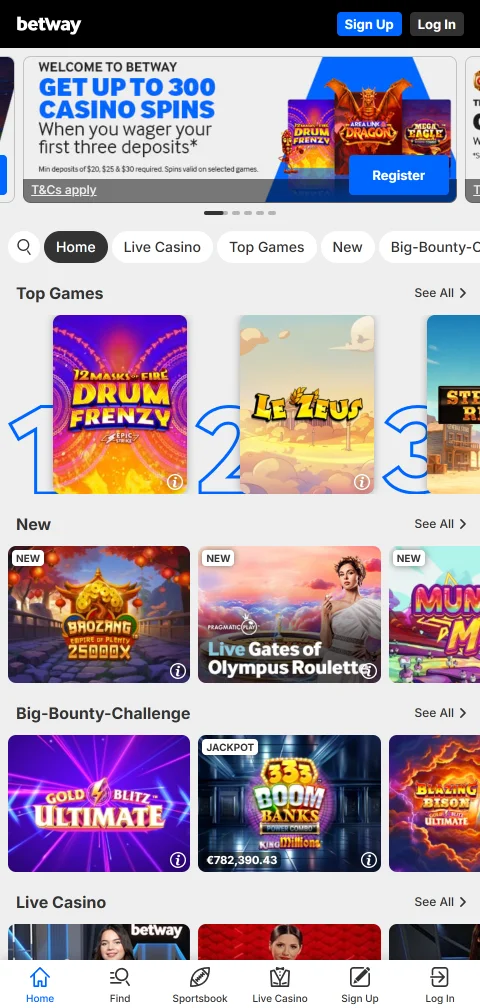
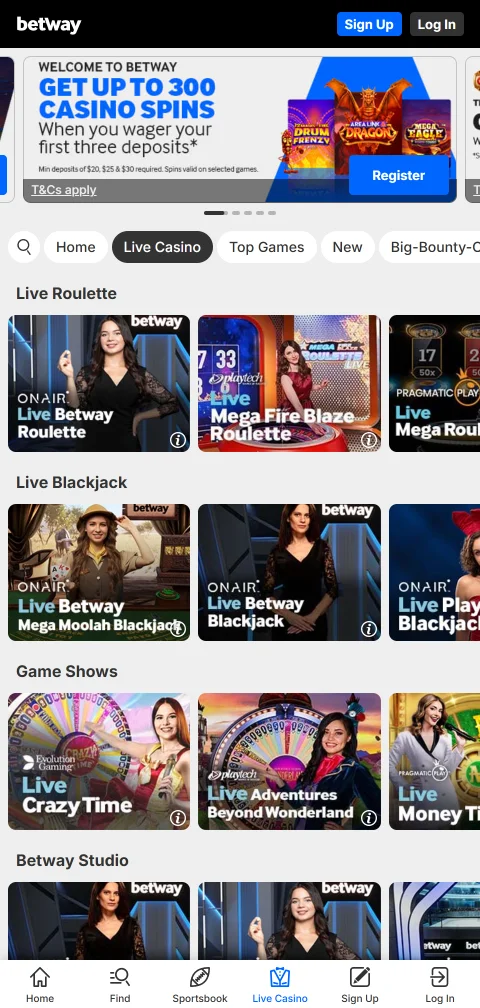
- Malta Gaming Authority licence MGA/B2C/130/2006 covers the casino product for Irish players
- GRAI register lists Betway for remote sports betting since the July 2026 licensing round
- Stated withdrawal processing within 24 hours, with one to two days in total
- Welcome offer starts from a €5 debit card deposit, lower than many rivals
- Bonus spins carry 50x wagering, and the offer expires seven days after registration
- Free bet returns winnings only; the €50 stake itself is never paid back
- Ireland has no online casino licence yet, so casino play relies on Malta
Withdrawals processed within 24 hours, 24-48 hours in total, by debit card, PayPal or open banking: Betway Casino payments analysis.
How we ranked these jackpot slot casinos
The ranking is built from published material: bonus terms, payment pages, game help files, licence registers and support answers quoted as given. Commission arrangements and the size of a jackpot ticker on the homepage do not move a casino up or down this list.
Bonuses and how they treat jackpot games
Many offers exclude progressive slots from wagering or bar free spins from winning a pool. A casino rises when its terms name the jackpot titles that count, at what percentage, and confirm that a pool won during a bonus is paid in full. It drops when jackpot games sit on a vague restricted list, or when a cap such as five times the bonus could, on a literal reading, apply to a pool win.
Payout speed for large wins
A jackpot win is the one withdrawal that will meet every limit a casino has. Placings rise where the terms state that progressive wins are exempt from weekly or monthly withdrawal caps and are paid as a lump sum. They fall where a seven-figure prize would be released in instalments of a few thousand euro a month, or where the instalment rule is buried in a general clause.
Jackpot selection and providers
We count which jackpot families are present, not how many titles carry the word. Networked pools, local pools and daily must-drop jackpots raise a placing when clearly labelled. A lobby of jackpot-branded games with no way to tell a network pool from a fixed prize lowers it.
Mobile use and the jackpot lobby
A jackpot section should show the live pool value and the game’s rules on a phone screen without leaving the lobby. Casinos rise when the mobile filter separates progressive from fixed jackpots. They fall when the ticker is only on the desktop site or the help file will not open in the mobile view.
Licence details and game certification
Jackpot maths depends on the random number generator, the software that decides each outcome, being tested by an independent lab. A casino rises when its licence can be matched on the regulator’s own register and its jackpot games name a testing lab or show a certificate. It drops when the licence number cannot be found on that register, or when a game’s RTP is shown nowhere a player can see it.
Customer support on jackpot questions
The question that matters before a big win is how a pool payout is verified and how long it takes. A casino rises when the agent answers specifically, names the KYC documents needed and points to the clause in the terms. It drops when the reply is a generic link or a promise that someone will be in touch.

What makes a slot a jackpot slot
A jackpot slot is any game with a prize that sits above its ordinary paytable, paid when a separate trigger fires rather than when a particular line of symbols lands. That separate trigger is the whole difference, and it explains most of what follows on this page.
There are two broad families. A fixed jackpot is a set amount, often a multiple of the stake such as 5,000 times the bet, and it never grows. A progressive jackpot grows with play: each qualifying spin adds a small slice of the stake to a pool, and the pool keeps rising until somebody wins it and it resets to a seed value.
Progressives split again by how far the pool reaches. A standalone progressive grows only from one game at one casino, a local pool is shared by several games at one operator, and a network or wide-area pool collects from every casino carrying the game, which is how the largest prizes reach into the millions. A must-drop jackpot adds a deadline, promising the pool will pay before a stated time or before it reaches a stated cap, so the trigger is tied to the clock or the amount rather than left entirely open.
None of these types changes the basic rule that each spin is independent.
Where the jackpot money comes from
RTP, the return to player, is the share of all money staked that a game pays back over a very long run of spins. On a jackpot slot that figure has two parts: the return from the base game and bonus features, and the contribution set aside for the jackpot. Studios usually publish the total, and the better help files show the split.
Take a worked example. Suppose a game lists a 96% RTP, of which 3 points fund the progressive pool. Over €500 of play, the long-run average says €480 comes back, but only about €465 of that arrives through ordinary wins; the remaining €15 has gone into the pot that, for nearly every player, someone else will collect. That is an average across millions of spins, never a forecast of your evening.
So a jackpot slot will often feel tighter than a regular slot with the same headline RTP.
The feeling is accurate. The money has not vanished, it has simply moved from many small wins into one very large and very unlikely one, and the base game is tuned lower to pay for it. Where the casino offers a studio title in more than one RTP version, a practice several studios allow, the version chosen shifts both parts, and the game’s own help screen is the only place to confirm which one is running.
Progressive network jackpot | Fixed jackpot |
|---|---|
| Prize can reach the millions as the pool grows | Prize is a set multiple of the stake |
| Base game return reduced to fund the pool | Full RTP stays in the base game and features |
| Top prize odds very long and rarely published | Top prize usually reachable through the paytable |
| Current pool value shown on a live ticker | Prize value printed in the paytable |
| Some pools require a minimum or maximum bet to qualify | Every stake level can win the top prize |
| Large wins may meet withdrawal caps or instalment rules | Wins usually within normal withdrawal limits |
Odds, volatility and the 'due' myth
Volatility describes how a game spreads its RTP: a low-volatility slot pays small amounts often, a high-volatility one pays rarely but in larger sums. Jackpot slots sit at the far end of that scale by design, because a share of their return is locked into a prize most players never see.
Studios seldom publish the exact odds of the top prize, and where a help file does not state them we treat them as unknown rather than guessing. What can be said is how they behave. Each spin is settled by the random number generator on its own, so a pool that has climbed for weeks is no more likely to drop on the next spin than it was on the first.
This is where the most common myth does its damage. A large progressive is not “due”, and a pool that paid yesterday is not “cold”; the trigger has no memory. Must-drop jackpots are the one partial exception, since the game promises a payout before a cap, but even then the chance at any single spin is spread across every player on the network.
One session proves nothing either way.
Reading a jackpot game before you play
Everything a player needs to judge a jackpot slot is printed somewhere in the game or the casino terms. The difficulty is that it is printed in different places, and the casino lobby rarely brings it together.
What I check first is whether the help screen gives the RTP with the jackpot contribution separated out, because that one line tells you how much of the return you are trading for the pool.
Six checks on a jackpot slot
These checks run in the order the information is easiest to find, starting inside the game and ending in the casino’s terms and support chat.
- Step 1
Open the game's help screen first
Find the stated RTP and whether it includes the jackpot contribution. If the help file gives one figure without a split, note that the base game return is lower than that headline number. - Step 2
Identify the jackpot type and reach
Check whether the pool is fixed, standalone, local or networked. The help file or the ticker label normally says so; a network pool grows faster but is shared across many casinos. - Step 3
Confirm the qualifying stake level
Some progressives only pay the top tier at a minimum bet, or scale the prize with the stake. Playing below the qualifying level can mean contributing to a pool you cannot win. - Step 4
Read the must-drop cap or time
For must-drop jackpots, note the cap or the daily deadline. This tells you how the pool is bounded, though it never raises your chance on any single spin. - Step 5
Check bonus and wagering exclusions
Look for jackpot titles on the restricted games list, and for clauses that cap winnings from bonus funds. A pool won during wagering may be treated differently from one won with cash. - Step 6
Find the large-win payout clause
Search the terms for withdrawal limits, instalments and the KYC needed before a jackpot is released. If it is unclear, ask support and keep the written answer.
Jackpot slots and the Irish rules
The Gambling Regulation Act 2024 set up the Gambling Regulatory Authority of Ireland, which is taking over licensing and supervision of gambling, including online casinos. Until its online licences are fully in place, many sites open to Irish players hold licences issued elsewhere, most often in Malta, and the licence that matters is the one you can verify on the issuing regulator’s own register.
For jackpot players the licence is not a formality. It decides who certifies the random number generator, who handles a complaint if a large win is disputed, and which rules govern how quickly that win is paid.
Check the register, not the footer badge.
Jackpot types side by side
The table sets the common jackpot structures against each other by how they are funded and triggered. It describes the mechanics as studios and casinos generally publish them; the exact figures for any single game are in that game’s own help file.
| Jackpot type | Funded by | Trigger | Prize size | Check first |
|---|---|---|---|---|
| Fixed jackpot | Base game paytable | Symbol combination | Set stake multiple | Bet level needed |
| Standalone progressive | One game, one casino | Random or symbol-based | Modest, grows slowly | Seed and reset value |
| Local progressive | Several games, one operator | Random or bonus game | Moderate | Which games share it |
| Network progressive | Many casinos, one game family | Random or wheel feature | Can reach millions | Contribution share of RTP |
| Must-drop jackpot | Pooled stakes | Before a cap or deadline | Bounded by the cap | Cap or drop time |
| Tiered jackpot | Shared pool, several tiers | Bonus wheel or pick game | From small to very large | Stake rules per tier |
What the ticker does not tell you
The live ticker is the most visible number on a jackpot slot and the least useful for deciding whether to play. A rising pool says how much has been staked since the last win; it says nothing about your odds, and nothing about how much of your own return has gone into it.
Two other numbers do more work. The first is the contribution share, which tells you the cost of the dream in RTP terms. The second is the casino’s payout clause for large wins, which tells you whether a prize, if it lands, arrives in one transfer or in instalments that run for years.
A sensible way to treat a jackpot slot is as a ticket priced into every spin, where the price is the gap between the headline RTP and the base game return. If that gap is three points and you stake €500, the expected cost of the ticket is about €15 over a long run. Whether that is worth paying is a personal decision, and the honest answer for most budgets is to play jackpot slots knowing the pool will almost certainly be won by somebody else.
Playing jackpot slots within your limits
Jackpot slots are built around a prize that almost nobody wins, and that is exactly what makes them easy to keep playing. A large pool can feel close when it is not, and losses on a high-volatility game can run for a long time before any return. Set a deposit limit before you start and treat whatever you stake as the cost of entertainment, not as a route to the jackpot. If you find yourself chasing a pool, raising stakes to qualify for a higher tier, or playing to win back losses, take a break and use the casino’s time-out or self-exclusion tools. Gambling is for adults aged 18 and over, and free, confidential support is available through the organisations listed below.
Before you chase the next jackpot
The number to carry away is the contribution share, the slice of RTP that leaves the base game to feed the pool. Three points of it costs about €15 per €500 staked on average, every session, whether the jackpot lands or not. This ranking would change if a casino began capping jackpot payouts or dropping the RTP split from its game sheets, and both were checked when the terms were last re-read on 22 October 2026. Odds on individual top prizes are not covered here, because studios rarely publish them.
Questions about jackpot slots
Is a jackpot slot's RTP lower than a normal slot's?
Not necessarily in the headline figure, but the base game usually returns less. Part of the stated RTP funds the jackpot pool, so on a 96% game with a 3-point contribution the ordinary wins return around 93% over the long run. The game’s help screen shows whether that split is published.
Is a big progressive jackpot more likely to drop soon?
No. Each spin is settled independently by the random number generator, so a pool that has grown for months has the same chance of paying on the next spin as on any other. Only must-drop jackpots are bounded, and even they spread that chance across every player on the network.
What is a must-drop jackpot?
It is a progressive pool that promises to pay before reaching a stated cap or before a stated time, often daily. The cap limits how large the pool can grow, but it does not make any single spin you place meaningfully more likely to win it.
Can I win a progressive jackpot with bonus money?
It depends on the casino’s terms. Some exclude jackpot slots from bonus play entirely, others count them at a reduced wagering rate, and a few apply a winnings cap to bonus funds. Check the restricted games list and the maximum-win clause before using a bonus on these titles.
Are large jackpot wins paid all at once?
Network jackpots are usually paid by the studio’s pool, and many casinos exempt them from withdrawal limits. Others apply monthly caps or instalments. The terms should say which, and KYC checks on identity and source of funds will normally come before any large payout.
Do I have to bet the maximum to win a jackpot?
On some games, yes. Certain progressives only award the top tier at a minimum qualifying stake, while others scale the prize to the bet or let every stake level compete. The help file states the rule, and it is worth reading before your first spin.
More about online casinos







When comparing these casinos, look first at whether the jackpot lobby separates network pools from fixed prizes. That label tells you more than the size of the ticker.