





















William Hill Casino review
| Key Feature | One account for sportsbook, Vegas, poker and bingo |
| Welcome Bonus | 200 free spins on Big William Hill Fortune for a €10 stake |
| Min. Deposit | Typically around €5-€10 depending on method |
| Number of Games | Approximately 1,700-2,000 |
| Game Providers | Playtech, Games Global, Red Tiger, ELK Studios, Pragmatic Play |
| Payment Methods | Visa, Mastercard, bank transfer, Apple Pay, PayPal |
| Payment Services | Visa Direct, PayPal, Skrill, Neteller, Paysafecard |
| Mobile App | iOS and Android (Vegas app) |
| VIP Programme | No public tiered VIP scheme confirmed |
| RTP | Typically around 94-97% per slot |
| Licence | Gibraltar Remote Gaming Licence 112 (casino); GRAI-1096-RB-26-0001 (sportsbook) |
| Operator | WH Ireland Limited (Evoke plc group) |
| Launch Date | 1934 (brand); online casino since the late 1990s |
| Legal Age | 18+ |



- Casino operated under Gibraltar Remote Gaming Licence 112, with the operator named in every footer
- Visa Direct card withdrawals stated at up to four hours, weekends included
- Support runs 24/7 through Messaging, and one login covers sportsbook, Vegas, poker and bingo
- Free spin winnings are capped at €30 and unused spins disappear after 24 hours
- Casino side is not yet licensed by the Irish regulator; no phone line confirmed for Irish players
For Irish punters, one login covers racing bets and around 1,700 to 2,000 casino games, with payouts of up to four hours by Visa Direct; the William Hill Casino editorial assessment weighs it.
bet365 Casino review
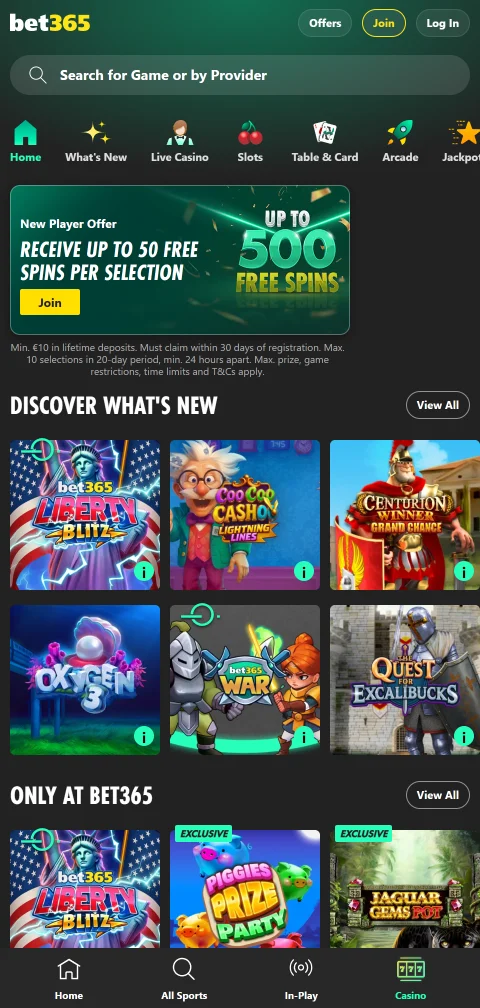
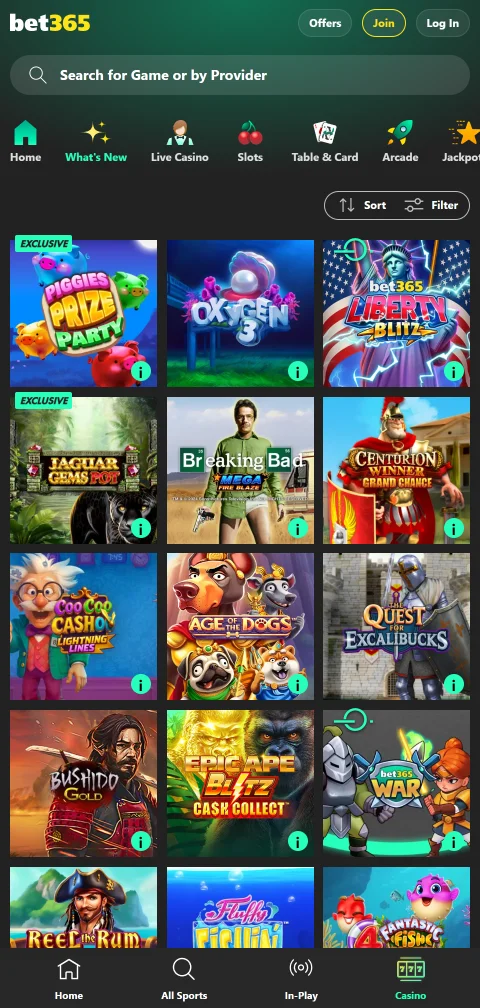
| Key Feature | One wallet shared with the bet365 sportsbook |
| Welcome Bonus | Up to 200 free spins over 10 days |
| Min. Deposit | €5–€10 depending on method |
| Number of Games | Approximately 1,500+ (unconfirmed) |
| Game Providers | Playtech, in-house titles and other studios (unconfirmed list) |
| Payment Methods | Visa Debit, Mastercard Debit, bank transfer, Trustly |
| Payment Services | PayPal, Apple Pay, Paysafecard |
| Mobile App | iOS and Android, casino inside main app |
| VIP Programme | No public VIP tiers published |
| RTP | Typically 94–97% on slots |
| Licence | GRAI remote betting; casino under MGA (check footer) |
| Operator | bet365 Group / Hillside entities |
| Launch Date | 2000 (bet365 brand) |
| Legal Age | 18+ |

- Stated withdrawal processing target of around four hours, with Visa Direct possibly inside two
- No fees on any listed withdrawal method, with bank transfers up to €50,000
- Free spins welcome offer needs only €10 in lifetime deposits to qualify
- Holds a GRAI remote betting licence, listed on the public Irish register
- Casino, sportsbook and live dealer games share one balance and one login
- GRAI has not yet opened casino licences, so casino cover still relies on Malta
- Free spins prizes of 5, 10 or 20 are randomised, not a fixed amount
- Withdrawals must normally return to the deposit method, which is awkward to change
- No published VIP ladder or tiered loyalty scheme for casino players
For Irish players, single-zero roulette at a 2.7% house edge, debit card deposits from €5 and fee-free withdrawals anchor the bet365 Casino value review, alongside a split GRAI and Malta licence position that every Irish depositor needs to read before funding an account.
Betfair Casino review
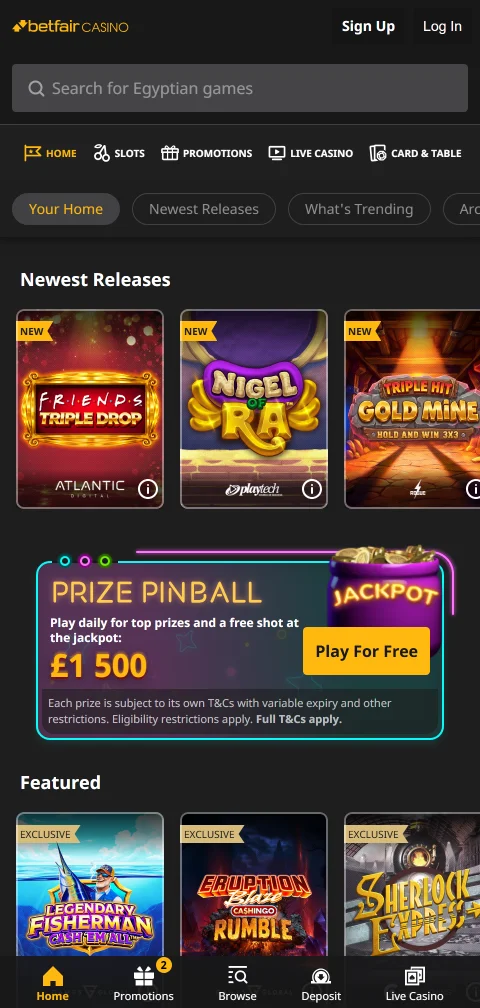
| Key Feature | Casino, sportsbook and Exchange on one account |
| Welcome Bonus | €2 free bonus, 1x wagering, 7 days |
| Min. Deposit | €5 via Pay by Bank; €20 standard transfer |
| Number of Games | Approximately 1,000+ titles |
| Game Providers | Blueprint (Jackpot King), Evolution, others |
| Payment Methods | Debit card, Pay by Bank, bank transfer, Apple Pay |
| Payment Services | Visa, Mastercard, Apple Pay, PayPal (typically) |
| Mobile App | iOS and Android apps, plus browser |
| VIP Programme | No public VIP scheme confirmed |
| RTP | Typically 94-97% on slots |
| Licence | GRAI (betting); MGA/CRP/131/2006 (gaming) |
| Operator | Flutter Entertainment plc group |
| Launch Date | Betfair brand founded 1999 |
| Legal Age | 18+ |


- Licence entities and numbers listed on a public regulatory information page, not buried in terms
- Pay by Bank withdrawals are stated at 1-4 hours, with a €5 minimum
- The €2 free bonus carries only 1x wagering, which is unusually light
- The Irish casino welcome offer is small next to the sportsbook and UK casino deals
- Standard bank transfers take 1-5 days and need a €20 minimum deposit
For an Irish player, value at Betfair comes from a single wallet across three products, €5 Pay by Bank minimums and payouts stated at 1-4 hours, as set out in our Betfair Casino editorial assessment.
PokerStars Casino review
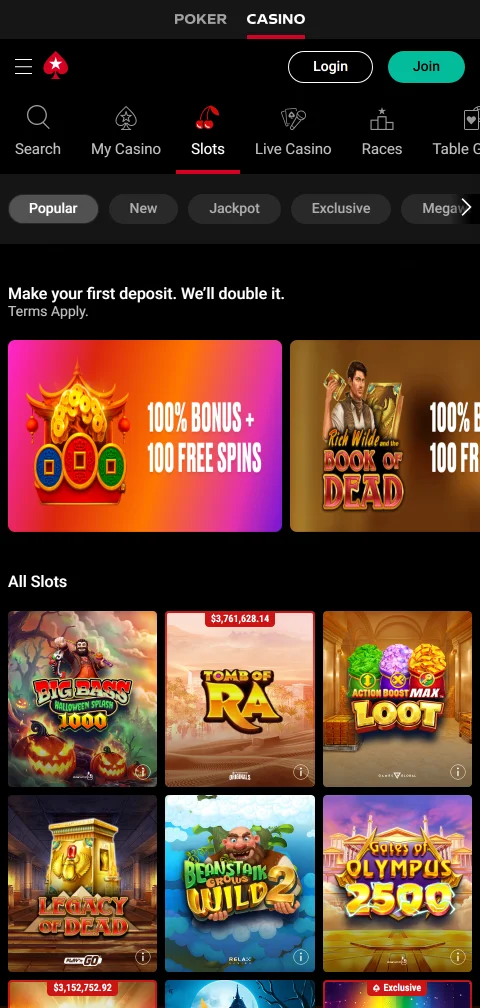
| Key Feature | One Stars Account for casino, poker and sports |
| Welcome Bonus | Typically up to €500, check current terms |
| Min. Deposit | Approximately €10 |
| Number of Games | Approximately 2,000+ |
| Game Providers | Evolution, Pragmatic Play, NetEnt, Quickspin |
| Payment Methods | Visa, Mastercard, bank transfer |
| Payment Services | PayPal, Skrill, Neteller, Apple Pay, Google Pay |
| Mobile App | iOS and Android apps, plus mobile browser |
| VIP Programme | Stars Rewards loyalty scheme |
| RTP | Approximately 96% on most slots |
| Licence | Malta Gaming Authority, MGA/B2C/213/2011 |
| Operator | TSG Interactive Gaming Europe Limited (Flutter) |
| Launch Date | 2001 |
| Legal Age | 18+ |


- Holds Malta Gaming Authority licence MGA/B2C/213/2011, verifiable on the regulator's public register
- Withdrawal approval capped at 72 hours, with PayPal, Skrill and Neteller credited within minutes afterwards
- One account and one wallet cover casino, poker and sports, which suits Irish players who use all three
- Live tables from Evolution and Pragmatic Play run comfortably in the mobile app and browser
- No Irish gaming licence: online casino licences from the GRAI do not open until 2027-2028
- Card withdrawals can take up to 10 business days after approval, which is slow by current standards
- The Irish welcome offer is not published in a form we could confirm; terms must be read at sign-up
Irish players access pokerstars.com under a Maltese licence, with deposits approximately €10. The PokerStars Casino Ireland assessment weighs those conditions against a library of approximately 2,000 games and card payouts taking up to 10 business days after approval.
888 Casino review
| Key Feature | In-house 888 slots and table games |
| Welcome Bonus | 100% up to €500, 40x wagering |
| Min. Deposit | €10 |
| Number of Games | Approximately 2,000+ |
| Game Providers | 888 in-house studio, Evolution, NetEnt, Pragmatic Play (approx.) |
| Payment Methods | Visa, Mastercard, PayPal, Skrill, NETELLER, Paysafecard, bank transfer |
| Payment Services | Skrill, NETELLER, PayPal, MuchBetter |
| Mobile App | iOS and Android apps, plus browser |
| VIP Programme | Yes, invitation-based VIP Casino Club |
| RTP | Around 95-97% on most slots, varies by title |
| Licence | Gibraltar Remote Gaming Licence No. 112 |
| Operator | 888 Eire Limited (Gibraltar) |
| Launch Date | 1997 |
| Legal Age | 18+ |



- Irish casino service licensed in Gibraltar under Remote Gaming Licence No. 112, named on every page
- Choice of welcome offers: 100% up to €500 or 100 free spins for a €10 deposit
- Operator history going back to 1997, with its own in-house slot and table studio
- Withdrawal timeframes published per method, including a one-day pending window for Gold VIP members
- Standard pending period of three business days before any withdrawal is processed
- 40x wagering on the match bonus, with Skrill and NETELLER deposits excluded from the offer
- Live chat only available while logged in and during operational hours, which are not published
For a player in Ireland, trading since 1997 and a Gibraltar licence weigh against a 4-10 business day payout window in the full 888 Casino analysis.
How we ranked casinos with no withdrawal fees
The ranking comes from published cashier terms, bonus rules, licence records and answers given by support in writing. A casino cannot buy a higher placing, and a large welcome offer does not move one if its withdrawal terms carry charges the cashier page leaves out.
Bonuses and the fees attached to them
A placing goes up when bonus terms add no withdrawal charge and the maximum cashout is stated plainly. It goes down when cancelling a bonus forfeits the deposit, or when wagering above 35x pushes you towards a cashout that triggers a fee anyway.
Withdrawal fees, payout speed and limits
This criterion carries the most weight here. A casino rises when every payout method is free, the pending period is 24 hours or less and the weekly cap covers a realistic win of €5,000 or more. It drops for any per-withdrawal charge, a fee below a minimum amount, one free withdrawal a week, or a charge on deposits not played through.
Games and software
A broad catalogue from audited studios raises a placing. It falls when popular titles run reduced RTP settings, or when the games counting towards wagering are so narrow that clearing a bonus before a free withdrawal becomes impractical for most players.
Mobile cashier and interface
The cashier on the app or mobile site has to show the same methods, limits and fees as the desktop version. A casino loses ground when the mobile cashier hides the fee line, lacks a working cancel option, or sends you to desktop just to upload ID for a payout.
Licence and how disputes are handled
A licence from a regulator with a published complaints route, such as the Malta Gaming Authority or the UK Gambling Commission, raises a placing, as does a stated policy on segregated player funds. A licence with no public register entry lowers it sharply. Terms that let the operator apply fees at its own discretion push a casino down the list or off it.
Customer support and written answers
Support that confirms in writing whether a method carries a fee raises a placing. Vague replies, live chat that opens only in office hours, or answers that contradict the published terms lower it, and a refusal to answer at all removes the casino.

What a no fee withdrawal really covers
A no fee withdrawal casino is one that takes nothing from the amount you ask to withdraw, whichever method you use and however often you cash out. That is the strict reading, and it is the one this page holds casinos to.
Most casinos that use the phrase mean something narrower. The cashier itself may charge nothing, while the terms and conditions add a fee in three or four specific situations that the banner never mentions. A casino can be honest about its cashier and still cost you money at the exit.
There is also a second party in every payout. Your bank, card issuer or e-wallet sets its own charges, and a casino that pays out free has no control over a Skrill currency conversion or a fee your bank applies to incoming non-euro payments. When we describe a casino as fee-free, we mean the operator’s side only, and the payment section below shows where the provider’s side can still bite.
What I check first is whether the fee policy sits in the general terms or only on the cashier page.
The cashier page tends to be the friendlier of the two. The general terms are what the operator relies on in a dispute, so where the two disagree, the general terms are the ones that count.
Where withdrawal charges hide in the terms
Fees rarely appear as a plain line saying “withdrawals cost €2.50”. They come attached to a condition, and the condition is usually something an ordinary player trips over without noticing.
Charges below a minimum amount
Some casinos pay out free above a threshold and charge a flat fee for anything smaller. If you tend to cash out small wins, this is the clause that matters most to you.
Limits on the number of free withdrawals
A common shape is one or two free withdrawals a week or a month, with a fee on every request after that. It reads as generous until you split a payout because of a daily limit and pay for the second half.
Fees on deposits that were not played through
This one catches people most often. Many operators require a deposit to be wagered at least once, sometimes up to three times, before it can be withdrawn, and they apply an administration charge, often stated as a percentage, if you withdraw it untouched. The stated reason is anti-money-laundering control: a casino does not want to work as a free transfer service. The rule is legitimate in principle, but it turns a “free” withdrawal into a paid one for anyone who deposits, changes their mind and asks for the money back.
Inactivity and dormant account fees
A monthly charge on an account left untouched for a year or so is not a withdrawal fee in name, though it drains the same balance.
Currency conversion
If the account is held in euro and the e-wallet in sterling, someone converts the money. The cashier may call the withdrawal free while the exchange rate quietly does the charging.
Pending periods and the reversal option
A withdrawal that costs nothing can still take longer than it needs to, and the delay usually sits with the casino rather than the bank. Payout time has two parts: the operator’s pending period, during which the request waits for approval, and the time the payment method takes to deliver the money.
Pending periods we see in published terms run from a few hours to three working days, and they are longest on a first withdrawal or after a change of payment details. A casino can advertise fast payouts while its terms allow several days of pending time.
The reversal button deserves its own warning.
During the pending period many casinos let you cancel the withdrawal and return the money to your balance with one click. It costs nothing, which is exactly the problem: reversing a withdrawal to keep playing is a recognised pattern in problem gambling, and a long pending period gives it more room. Some operators let you switch reversals off or ask support to flush a withdrawal immediately. Casinos that offer either get credit in our ranking, because a free withdrawal you cancel three times has not saved you anything.
Payment methods, fees and payout windows
The table sets out the payout windows Irish-facing casinos commonly publish for each method after approval, together with the step where a payout tends to stall. Figures are ranges from operator and provider terms, not timings of any single payment.
| Method | Usual payout window | Provider fee risk | Where it stalls |
|---|---|---|---|
| Visa or Mastercard debit | 1-5 working days | Low in euro | Card not eligible for payouts |
| PayPal | Within 24 hours once approved | Conversion if not euro | Account name mismatch |
| Skrill or Neteller | Within 24 hours once approved | Conversion and wallet fees | Often excluded from bonuses |
| Revolut (via bank transfer) | 1-3 working days | Low in euro | Gambling block left on |
| SEPA bank transfer | 1-3 working days | Low within SEPA | Bank details check |
| Apple Pay or Google Pay | Paid to linked card, 1-5 days | As the linked card | Method not open for payouts |
Checking a cashier before you deposit
Every fee described above is written down somewhere before you hand over a cent. The trouble is that it is spread across three or four pages, and nobody reads the general terms until a withdrawal goes wrong.
Ten minutes before the first deposit settles most of it.
Six checks for a fee-free cashout
These checks follow the order a withdrawal travels, from deposit to bank account. Each one answers a question the cashier banner leaves open.
- Step 1
Read the general terms fee clause
Search the general terms for "fee", "charge" and "administration". The cashier page is a summary; the general terms decide disputes, and any conditional withdrawal charge will be written there. - Step 2
Confirm the deposit wagering rule
Find out whether a deposit must be wagered once or more before withdrawal, and what percentage is charged if it is not. This is the fee most players meet without expecting it. - Step 3
Check minimums and free withdrawal counts
Note the minimum withdrawal, whether smaller amounts carry a charge, and how many free withdrawals you get each week or month before fees start. - Step 4
Match deposit and payout methods
Most casinos pay back to the method you deposited with. Apple Pay, Google Pay and some cards cannot receive payouts, so confirm your route out before you choose your route in. - Step 5
Get the fee answer in writing
Ask live chat or email whether your chosen method carries any fee, and save the transcript. A written answer is what you point to if a charge appears later. - Step 6
Verify ID before your first withdrawal
Upload identification and proof of address straight after registering. Unverified accounts are not paid, and the first withdrawal is where most delays begin.
ID and source-of-funds checks at withdrawal
Know Your Customer checks cost nothing in fees, yet they are the step where a free withdrawal most often stalls. The casino will not release money to an unverified account, and the first payout request is usually what triggers the review.
Standard KYC asks for photo ID, a proof of address dated within the last three months and sometimes a photo of the card you deposited with, with the middle digits covered. Approval times published by operators range from a few hours to several working days, and they stretch when a document is blurred, cropped or in a different name from the account.
Source-of-funds checks are a separate matter. They tend to appear once deposits or winnings pass a threshold the operator does not publish, and they ask for payslips, bank statements or similar evidence. A request like this is an anti-money-laundering obligation, not a sign that something is wrong with your account, but it can hold a large payout for longer than any pending period.
Name, address and payment account have to match exactly.
Fee-free outright or fee-free with conditions
The casinos that call their withdrawals free fall into two groups. One charges nothing in any circumstance written into the terms; the other charges nothing as long as you stay inside a set of conditions.
The second group is not dishonest, and for some players it works just as well. The comparison below shows where each one comes out ahead.
Fee-free outright | Fee-free with conditions |
|---|---|
| No charge on small withdrawals | Flat fee below a minimum amount |
| Unlimited free requests | One or two free requests per period |
| Deposit wagering rule may still apply | Deposit wagering rule usually applies |
| Lower weekly caps at some sites | Higher caps sometimes offered for VIP accounts |
Licensing while Irish casino licences are pending
The Gambling Regulation Act 2024 set up the Gambling Regulatory Authority of Ireland, and the GRAI now licenses remote betting. Online casino games fall under a separate remote gaming licence, which the regulator has scheduled in a later phase planned for 2027 to 2028.
Until those gaming licences are issued, every online casino serving Irish players does so on a licence granted elsewhere, most often by the Malta Gaming Authority or the UK Gambling Commission. Neither gives you a complaints route to an Irish body. What they do give you is a published register and a regulator you can escalate a fee dispute to, which is why a licence without a findable register entry lowers a casino on this page.
One rule already applies to operators licensed in Ireland: since 5 February 2026 they cannot accept credit card deposits, including e-money funded by a credit card. Casinos licensed abroad are not bound by that rule, and a casino still taking credit cards is worth a second look at its other terms.
Check the licence number in the footer against the regulator’s own register, not against a badge.
Free withdrawals and keeping gambling in check
A free withdrawal is only worth something if you actually take it. Set a deposit limit in your account before you play, and decide in advance what share of any win goes straight back to your bank. If the reversal option tempts you to put a pending withdrawal back into play, ask support to process it immediately or to switch reversals off where the casino allows it. Cooling-off periods and self-exclusion are available in account settings at licensed casinos, and Revolut and several Irish banks let you block gambling payments from the app. Gambling is entertainment that costs money, not a way to earn it. If it has stopped feeling like a choice, the support organisations listed below are free and confidential.
What to do before your first fee-free cashout
The order matters more than the casino. Verify your ID first, then check the deposit wagering rule, then choose a payout method the cashier actually supports for withdrawals. The listing above was last checked against published terms on 13 August 2026, and a casino drops off it the moment its terms add a charge on any method it pays out to. What this page does not cover is your bank’s side: a euro payout into a sterling wallet can still cost you, and only your provider’s fee schedule will tell you how much.
Questions about no fee withdrawal casinos
Do no fee withdrawal casinos really charge nothing?
They charge nothing on the operator’s side when you stay inside the terms. Fees can still come from a minimum-amount rule, a limit on free requests or an unwagered deposit. Your payment provider may also charge separately, for example on currency conversion, and that sits outside the casino’s control.
Why would a casino charge me for withdrawing my own deposit?
Many casinos require a deposit to be wagered at least once before withdrawal, as an anti-money-laundering control. If you withdraw it untouched, an administration fee, usually a percentage, can apply. The rule is in the general terms, so read it before depositing rather than after.
Which payment method is fastest for a free withdrawal?
E-wallets such as PayPal, Skrill and Neteller commonly pay within 24 hours once the casino approves the request. Debit cards and bank transfers usually take one to five working days. Approval itself depends on verification, so an unverified account is slow whichever method you pick.
Can I withdraw to Revolut from a casino?
At some Irish-facing casinos you can, although the payout often travels as a bank transfer to your Revolut IBAN rather than to the card. Revolut also has a gambling block that can stop deposits; if you switch it off, the change can take up to 48 hours to apply.
Can I withdraw with Apple Pay or Google Pay?
Often not directly. Many casinos accept Apple Pay and Google Pay for deposits only and pay winnings back to the linked card or by bank transfer. Check which methods the cashier lists under withdrawals before you choose how to deposit.
Is a withdrawal fee the same as an inactivity fee?
No. A withdrawal fee applies when you cash out, while an inactivity fee is a monthly charge on an account left unused for a set period, often twelve months. Both reduce your balance, so a casino with no withdrawal fee can still charge you for leaving money sitting there.
Are online casinos licensed in Ireland?
The GRAI licenses remote betting, while online casino licences come in a later phase planned for 2027 to 2028. Until those are issued, casinos serving Irish players hold licences from regulators such as the Malta Gaming Authority or UK Gambling Commission, which you can verify on their public registers.
More about online casinos







Compare the weekly cap before the payout speed. A casino paying within 24 hours is little help if its cap holds most of a large win back for weeks.